Showing posts with label 60s. Show all posts

March 21, 2020

CHARADE (1963)


Charade is a film I've been meaning to cover for quite a while but could just not form the words for. Often dubbed as "The best Hitchcock movie that Hitchcock never made", it's a film that's gone down in film history as "lightning in a bottle" in so many ways.

Audrey Hepburn as Regina "Reggie" Lampert

Cary Grant as Peter Joshua (and far too many other names to fit here)

Ned Glass as Leopold W. Gideon

James Coburn as "Tex" Panthollow

George Kennedy as Herman Scobie

Jacques Marin as Insp. Edouard Grandpierre

Walter Matthau as Hamilton Bartholomew

Swept into a race to find $250,000 stolen by her recently-deceased husband Charles, interpreter Regina Lampert finds herself paired with dashing stranger Peter Joshua, who helps and protects her when Charles' old WWII comrades come after her for the money. All the while, new names are introduced, shaky alliances are formed, and Regina has to think for herself and act fast when her trust in Joshua starts to falter.

Charade's "centerpiece", if you will, is the push-pull
relationship between Regina and "Joshua".

Adapted by Peter Stone (The Taking of Pelham One Two Three) from his novel The Unsuspecting Wife (based on an earlier screenplay by him and Marc Behm), Charade could have gone wrong in so many ways. Providing the audience a real sense of danger through its great villains, Charade also keeps in the air its important romantic comedy elements, great locations, and a sense of cinematic fun all the way through.

"Meglio stasera, che domani o mai..."

Indeed, Charade is a difficult film to describe because all in all, it flows and moves so naturally that it "sucks you in", sweeping you up in its pacing, music, dialogue, and thrills. This is likely chiefly thanks to Stone's script and Stanley Donen's swift direction, taking the audience right along with the characters.


Special credit should be given to cinematographer Charles Lang
(Some Like It Hot) for his excellent use of light and shadow.

Unlike many thrillers a "bad movie fiend" could name today, Charade benefits tremendously from its characters acting like actual (mostly-logical) human beings. Grant's character may constantly lie due to his motivation, Regina may fall a bit victim to her feelings for him, and Tex, Scobie, and Gideon are often fuelled by their own paranoia and greed, but they are all still smart, intuitive, and clever, participating in the film's constant battle of wits.

Charade's baddies are dangerous and intimidating, but still fun and energetic.

You know a screenplay is great when even its secondary characters 
are memorable. Insp. Grandpierre is a hilarious audience mouthpiece
in lampshading the inherent absurdity of the plot.

While there are a few dated cultural aspects that will make viewers double-take a bit (Regina having married Charles impulsively, Sylvie's skewed priorities on marriage, Regina's preference for unfiltered cigarettes, how no one really comments on Jean-Louis having been kidnapped after the fact), Charade avoids a lot of baggage that many actual Hitchcock films have in that it gives us an excellently written, autonomous female protagonist.

Be honest. Even those with a cursory knowledge of Hitchcock films 
would probably expect a lot worse to happen to Regina.

A fast thinker and a fast actor, Regina is far from incapable in her situation, but is still human and flawed enough for the audience to understand and to keep invested in. Clearly the audience surrogate due to the unusual situation she's thrown into, the casting amplifies this to the hilt. No one wants anything bad to happen to Audrey Hepburn, after all.
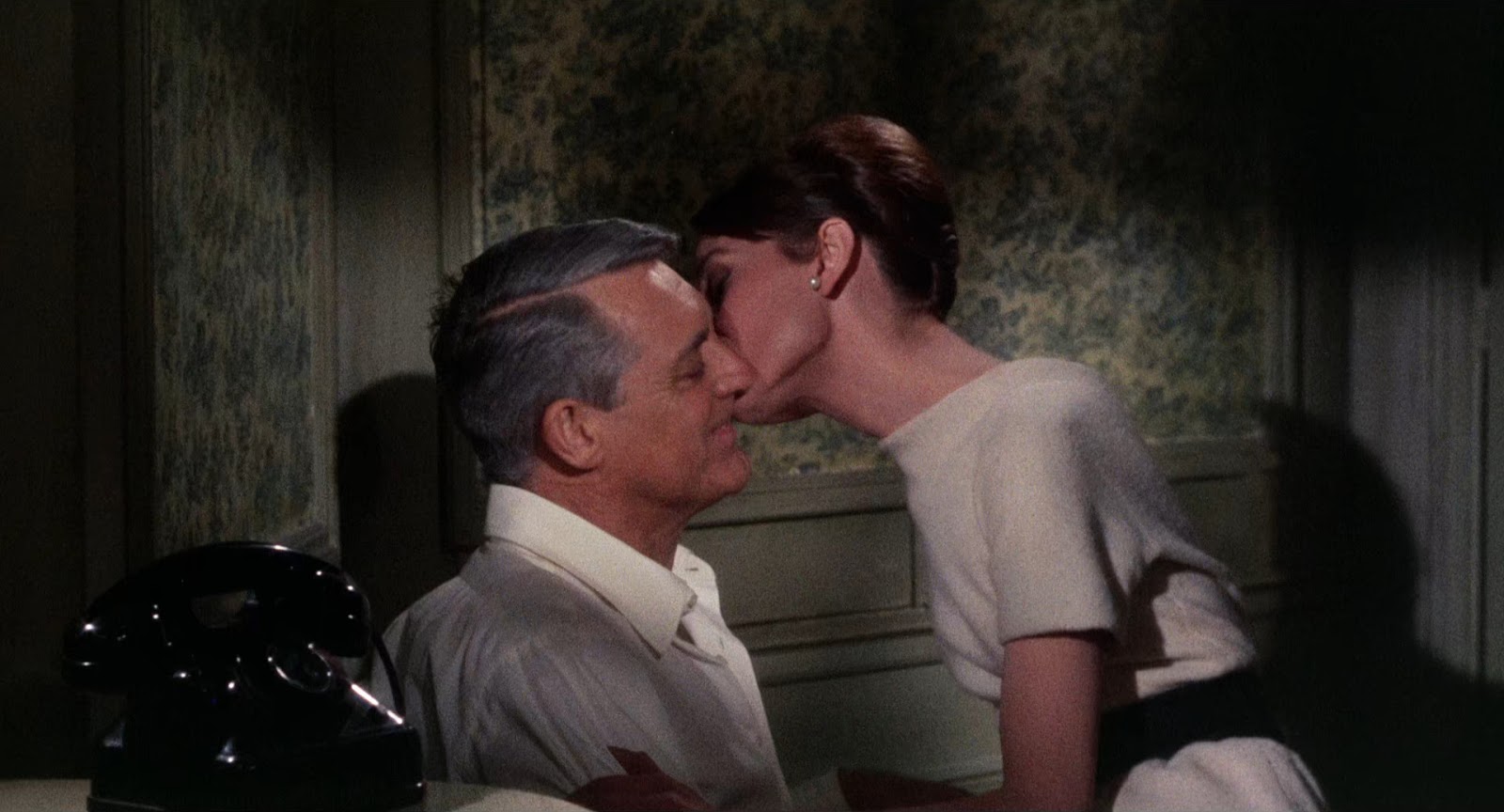
The decision to have Regina be the pursuer rather than Grant's character 
saves Charade a bundle of awkwardness in- and out of universe.


Matthau, in the pre-Fortune Cookie phase of his career, is so fantastic, 
you'll wonder how he didn't attain star status sooner.

It's the role of the script and great direction that not only enables Charade to balance its many different tones (its editing and short bouts of violence still hold up today), but also helps it to many rewatches.

AND THE REST... 

Thomas Chelimsky as Jean-Louis Gaudel (center),
who always resembled a young Robin Williams to me.

Paul Bonifas as stamp dealer Mr. Felix,
a small but standout role.

Writer and screenwriter Stone (left) cameos in Regina's arrival
at the U.S. Embassy, dubbed by director Donen.

LOGO GEMS


Charade marks the first appearance of the 1963 - 1990 Universal Pictures logo, in its standard (or "flat" 1.66) aspect ratio version.

OTHER OBSERVATIONS

This shot of Matthau (where he gives Hepburn his condolences)
has always looked too bright (overexposed?) to me, especially
compared to the other shots of him in that scene.

Me, on a not-as-regular-as-it-should-be basis.

Charade's use of real Paris locations are worth the price of admission alone.

TIDBITS AND SUCH

Check out Stanley Donen and Peter Stone's audio commentary (currently on the Criterion Blu-ray) the next time you watch Charade. Not only for their trivia, but also, amusingly, for their bickering over details.

Read James Coburn's daughter-in-law Robyn L. Coburn's review for Charade (with great trivia), as well as for his other films here.

Vanity Fair caught up with Thomas Chelimsky (Jean-Louis) in 2017.

Charade is a film that has fast become a "comfort food" movie for me, a fun, witty, all-encompassing experience that will be "on standby" for many years to come. 


Copyright © Chynna Moore

January 18, 2020

TRUE GRIT (1969)


First and foremost, I'm not generally what you call a western fan. Mostly, this is due to the time period I grew up in (1992's Unforgiven being considered "the last great modern Western"), but also their subject matter being no longer a good fit for kids in the era of multiculturalism. But what is it about 1969's True Grit that appeals to even non-western fans (like my fellow film reviewer Ken Anderson)? Let's find out.

Kim Darby as Mattie Ross

John Wayne as U.S. Marshal Reuben "Rooster" Cogburn

Glen Campbell as Texas Marshal La Boeuf

While certainly tailored to the pre-Easy Rider moviegoing taste, Henry Hathaway's film adaptation of Charles Portis' novel brings an easy, unhurried energy, capped by sprawling landscapes and Elmer Bernstein's lovely trumpet, guitar, and strings-driven score. Special credit should also be given to Marguerite Roberts' screenplay, which retains the three-dimensional characters while dispensing with some minor characters and details.


True Grit doesn't give us more than it needs to in
showing Mattie and her father's relationship dynamic.

Even though her role is ever-so-slightly reduced in comparison to the book and the 2010 film, I never had to put on my "different time" glasses when watching Mattie Ross. In an era where over-correction leads to many female characters having no flaws or interesting personalities, Mattie is arguably more refreshing now than she was in 1969. A well-rounded, nuanced, three-dimensional teenager understandably driven by her father's murder, Mattie is thrown into several dangerous situations, but still proves at least somewhat capable, even if she loses in the moment. 

Even though she's unprepared and untrained regarding guns, 
Mattie still fearlessly gets several shots in.

Darby's controlled manner as Mattie makes her
few displays of grief all the more heart-wrenching.

Jeff Corey as Tom Chaney, a character whose relative
patheticness avoids genre cliche.

The sequence of Mattie's father's murder is quite brief,
adding to how quickly and senselessly one can die.

Mattie's expert negotiating skills rouse the eventual interest of U.S. Marshal "Rooster" Cogburn, a slovenly drunkard who everyone in the film seems to know by name and moreso his reputation. It's because of his "true grit" (read: "getting the job done"), not in spite of it, that Mattie seeks him out. 


Not having seen a lot of Wayne films in general (my first, The Man Who Shot Liberty Valance, seemed to doubly establish the fodder that Wayne and costar Jimmy Stewart would be mercilessly parodied with to this day), True Grit is the first "good" Wayne film that I've seen, and it certainly lives up to it, especially regarding the Duke's performance.

Kitteh!

By all accounts feeling out of his element before starting in the role, you get no sense of that in Wayne's performance. Languid, yet decisive, rough, yet murmuring with heart and likability, in Wayne we see Rooster's slight affection for Mattie start well before he's trying to protect her.


As far as musicians-turned-actors go, Campbell is actually pretty good as La Boeuf, infusing him with charm, that little bit of condescension (especially talking to Mattie), and a bit of ego in regards to Rooster and his methods. (Though my meter might be skewed, seeing as nowadays, musicians acting are generally relegated to guest spots in procedural dramas.) Basically, 60s westerns could do a lot worse than him in a main role.

True Grit's performances solidify the diametrically-
opposed personalities that make up its main trio.

Rooster talking about his old life with his ex-wife
and clumsy son was a favorite scene of Wayne's.

Robert Duvall as "Lucky" Ned Pepper

For a villain who's not even the main villain of the story, Duvall's Pepper proves why he's so successful, notorious, and feared. Pragmatic enough to know Chaney is a serious liability, he turns his attention to Rooster, who stands more of a chance of killing him. Fresh off of films such as To Kill a Mockingbird and Bullitt, Duvall would soon hit it big with M*A*S*H and the Godfather films shortly after.

Colorado's sagebrush reminds me of spending
summers in the Okanagan Valley. In fact, many films
have been filmed there, standing in for several U.S. states.

Some viewers might be disappointed by the main characters not setting off on their journey until about an hour into the runtime, and perhaps the genre artificiality is apparent (not so much for me, an obvious set or two aside), but True Grit's characters mark it a head above many of its contemporaries.

While ending the film happier than in the 2010 film,
the characters still go through hell getting there.

AND THE REST...

Ken Renard as Yarnell

James McEachin as Judge Parker's Bailiff

Alfred Ryder (Star Trek: TOS) as Defense Attorney Goudy

H.W. Gim as Chen Lee, a guy who reminds me 
a lot of my own grandfather.

Strother Martin as Col. G. Stonehill

Jeremy Slate and Dennis Hopper 
as Quincy and "Moon", respectively.

John Fiedler as Lawyer Daggett

LOGO (MOUNTAIN) GEMS


True Grit is one of the few Paramount films where the stars, byline, and company name are in shadow mode. (The changes in the company name's font, byline appearance, and the removal of two stars wouldn't happen until 1974.)


Copyright © Chynna Moore