Showing posts with label Gene Hackman. Show all posts

May 14, 2021

WRITING DIALOGUE: A FEW WAYS TO GO

"Hey, I don't remember saying that..."

I've said in previous posts how dialogue can really pull double duty in revealing character, motivations, dynamics, etc. Because it is such a flexible facet of the screenplay form, it is arguably the most vital part of it by far. Here are a few touchstones to consider when crafting your dialogue.

CONSIDER YOUR GENRE (AND TONE)

A farce needs an impeccably staccato symphony of energetic words, a western is more visually oriented than dialogue-heavy, and a musical may require characters to act in a heightened tone to fit surrounding songs. It's about execution, after all, and few other things in film are immune to the effects of the wrong tone.

"I'm not an American, I'm a nymphomaniac."
This line fits the tone of the film, folks. Trust me.

DIFFER YOUR "VOICES"

Indeed, dialogue can make a character "leap off the page" and gives the reader an idea of what they're like without the help of visuals.

Keeping Up Appearances forms its premise around basically one joke:
how much of a snobbish, "prim and proper" force of nature one woman can be.

THE "HEMS" AND "HAWS"


In real life, people say "um", "er", and countless other sounds and punctuation that would be anathema to a traditional screenwriter. But I say, it's a subtle and sneaky way to humanize your characters. Keep in mind the need for rhythm and flow in your dialogue, of course. 

THE "REPEATS" AND "CHEKHOV'S QUOTES"

Characters oftentimes repeat important words, information, quotations, etc., whether from an in-universe source or from other characters. Of course, have fun with this. Does a character misquote another? Are they mocking the original line? Or repeating a word of advice? Even intentionally cheesy can work if you aim for earnestness, sweetness, and heartwarming.

Or alternatively, smarmy and sociopathic.

READ, READ, READ!


Never forget to read your dialogues back in your head (and even aloud). You'll gain a better idea of wording, flow, voices, etc. It can even just be a difference in one more or one less syllable, so trust your reader's instinct.

Copyright © Chynna Moore

January 12, 2021

ROOMS IN A VIEW: DECIDING YOUR SETTINGS


It can be easy to take for granted the importance of setting in a scene. Setting, however, is one opportunity of many to deepen the overall story. Here are a few useful pointers to keep this setting from being boring on paper and onscreen.

WHAT IS GOING ON IN THE SCENE? WHO IS IN IT?

Action and plot come first if you're undecided on a setting for your scene, or the setting you currently have just isn't working. Let your eventual setting choice accommodate those first, of course, before deciding on the multitude of factors below.

For Rick Dalton to simply be told what kind of character he's playing on Lancer would be boring. 
In the show's hair and makeup trailer, however, he's confronted with the aesthetic aspects of 
his villainous character as well as those of the currently-popular stars of 1969,
driving home just how "out of time" he truly feels.

WHAT IS THE SPACE?

Is it wide open? Claustrophobic? Old, decrepit? Or new with the plasticky smell still present? What are the sounds? If your scene takes place indoors during the summer, it's likely the A/C will be heard in the background. Outside, you'll likely hear birds and passing cars. Is it a setting that's loose and laid-back? Or uptight and solemn?

Lex Luthor repurposes an abandoned subway station into his lair, which is large and grand
in nature, but still possesses his means of villainy and "hiding in plain sight".

WHAT PROPS WILL BE THERE?

No props would be fine if your scene in question is about two characters merely verbally sparring, but especially in comedies, it's important to remember that props can be your friend. After all, a character's stern point can be undercut by a considerably sillier prop.

This would not be an example of the above.

HOW WILL THEY INFORM YOUR CHARACTERS (AND VICE VERSA)?

Is the setting intrusive enough to affect the characters' conversation? Or so deadly quiet that they feel exceptionally nervous and self-conscious? It may not even influence their conversation directly, but perhaps it's not as secure as they think. Like props, let the room be your friend.

The claustrophobic, bustling courthouse press room in The Front Page (1974) influences
Hildy Johnson's tension in hiding Earl Williams from his fellow press men.

ARE THERE PARALLELS OR THEMATIC CONNECTIONS?

Similar to the above, the room in question can be indicative of a character's personality, past, present, and future. Is it as stifling as their nature? Open and barren? Or just there because the character is barely in there to begin with?

Despite being one of the smaller spaces in Luthor's lair, this map room is spacious, with plenty of room
for Luthor's various computers (because 1978), furniture, and distance between him and
Miss Teschmacher, signifying their opulent, but emotionally cold dynamic.

ARE THEY REAL? FICTIONAL? 

Real locations can be enhanced with regional and other details (see in my "Screenwriting" tag), but a fictional setting can still parody a real one to hilarious effect. What are its further surroundings? Is the larger setting the Mojave desert? Or Churchill, Manitoba with polar bears?

Three words that strike fear into the hearts of animal lovers
and lovesick old folks alike.

Copyright © Chynna Moore

March 4, 2020

THE SPARK, THE "EVEN BETTER", AND GOING WITH YOUR GUT


The emotional side of screenwriting often proves to be a flurry of feelings, instincts, and syntheses of ideas with time. You'll find yourself pouring your pain, joy, suffering, and even relief into your script (depending on the story), realizing its emotional honesty, and elevating it well beyond your initial idea.

Three of these (related, but not necessarily consecutive) signs are important to identify, since for me, they've proven to be valuable in knowing when a script I'm writing is resonating with me.

THE SPARK


Have you gotten an idea that's led you to endlessly scribble down other ideas, details, and plot points? Has it revved up your creative motor to such a high degree that you can't think of anything else?

Then inspiration has struck.

It has grabbed you, like a good story just grabs its audience, and it simply won't let go. You have to write it now, and even if you don't yet have every detail nailed down, you know enough of the "skeleton" for it to keep your interest, well enough for you to see this story through.

The story could be based on something that happened to you, or not. Or its outcome is the total and more dramatic opposite. Or it's an older idea you had filed away that has now gained new life combined with another old or new idea.

Whatever it is, if it has grabbed you, don't ignore it.

THE "EVEN BETTER"


At this point, you have a good idea of where your story is going to go. Say you've had some time to let said story, its characters, and their own emotions "sink in", especially if they're based on parts of yourself. Now you've gotten to the script's emotional climax (though this "even better" could be at any point in the scriptwriting process).

Suddenly, you may find your own emotions (channeled through your characters) taking over. One character lets out their anger even more because you've "grown attached" to them and want them to express themselves further. Another character might feel greater remorse than you initially planned, whether it's in direct reaction to the first character or not. (Oftentimes, it is, like two great actors playing off each other.) Or alternatively, your two characters, while upset and just as angry as the previous examples, are both remorseful afterwards and want to be friends.

The key, of course, is the role of emotion. If these characters and events are rousing up your own emotions as a screenwriter, then chances are, they'll do the same (if not moreso) for your audience.

Now when I call this the "even better", I mean the end result of this heightened emotional component is the "oomph", the "gusto", the improved version of what you had planned before. Your characters have now come alive in a more emotionally honest way that hadn't been guaranteed. They've "paid off" your own emotional investment in a "2+2=5" manner.

Of course, it's best not to go seeking out this "even better" as you're writing. Creativity cannot be forced, remember, so let it all happen naturally.

GOING WITH YOUR GUT


Now, you might be at the stage where you've long refined, rewritten, dissected, shaded, and colored your script. It has life, a heartbeat, and a spirit of its own.

One day, you might think of changing a small part of your script, be it a sentence, a character action, or even just one solitary word. So you make that change.

But then, you feel that something doesn't sit quite right with it. It might not be terrible, but perhaps now it doesn't flow so naturally with the rest of the language you've chosen. It might imply something else that you never intended to allude to. Or maybe, you just can't formulate a reason at all why it doesn't feel natural. Perhaps you had simply "fixed" what hadn't been broken. So you change it back to the way it was, and all is right with the world.

That is your gut speaking.

You've become so attuned to your script's "heart" (emotional core), and how your characters and their dynamics truly are, that you can now sense when even the smallest detail feels "off", no matter how slight it is. This knowledge is quite powerful, and informs everything you visualize with said script. It also means your script is emotionally consistent enough for you to almost "predict" how these factors will be, even for situations that never actually happen in your script.

At the end of the day, only you will know what feels "right" for your script, and as a result, it will be as individual as you.


Copyright © Chynna Moore

January 26, 2020

SUPERMAN (1978)


In the summer of 2000, the same time my then-five-year-old brother tried to make lemonade with concentrated orange juice and hot sauce, he, my nearly-seven-year-old self, and our parents took one of our many trips to Tri-Star Video on Nanaimo's Bruce Avenue. I haven't the faintest memory what VHS tape I picked, but my brother's choice was Richard Donner's 1978 landmark.

Christopher Reeve as Superman...

...a.k.a. Clark Kent

Margot Kidder as Lois Lane

Jackie Cooper as Perry White

Marc McClure as Jimmy Olsen

Glenn Ford and Phyllis Thaxter
as Jonathan and Martha Kent

Marlon Brando as Jor-El

Jeff East as Young Clark Kent
Though he's dubbed by Reeve in the theatrical cut, 
East's voice can be heard at points in the three-hour T.V. cut.

Gene Hackman as Lex Luthor

Valerie Perrine as Eve Teschmacher

Even at my young age, while not grasping the littler story beats or character humor, the images of Krypton being destroyed, young Kal-El lifting the Kents' truck, Jonathan Kent's death, Superman finding Lois's body, or him spinning back the Earth left indelible impressions even back then.

Between then and early 2018, however, I didn't think back to Superman much, if at all. Not being a superhero fan in general, I certainly didn't intentionally avoid seeing Superman again, but additionally, none of the newer incarnations stuck out to me as worth seeing on a story or cinematic level, especially given how most of them tried ever-so-hard to avoid comparisons to the Donner films.

But funny enough, it was Bob Chipman's "Really That Good" episode on this film that really encouraged me to give it another look. Superman's more-needed-as-ever message of "something to believe in again" resonated not only due to the time, but also my own situation regarding my father, who was more in than out of hospital with both pancreatic cancer and the side effects of chemotherapy.
Without getting into the long of it, after he had passed from tumor-related sepsis a couple months later, it was this film that was one of the things that helped me though the (for me, short, but certainly emotional) grieving process. After all, it was after Jonathan Kent's death that Clark Kent left the Fortress of Solitude to go to Metropolis and be his best self.

Bank the wall, Supes, bank the wall...

Bank the wall, Supes...

Yes!

But getting back to the film, while I never not believed Christopher Reeve was Superman that first viewing, I completely missed back then how damn good he is in the role. Not to repeat Bob Chipman's assessment, but even if a better Superman film is eventually made, we might never get a better Supes than Reeve. Off-the-charts charm, this Superman has.

Seriously, I'm gay as hell, and even I'm practically swooning right now.

Reeve so completely sells being the "Big Blue Boy Scout",
brimming with pure earnestness rather than being over-the-top.

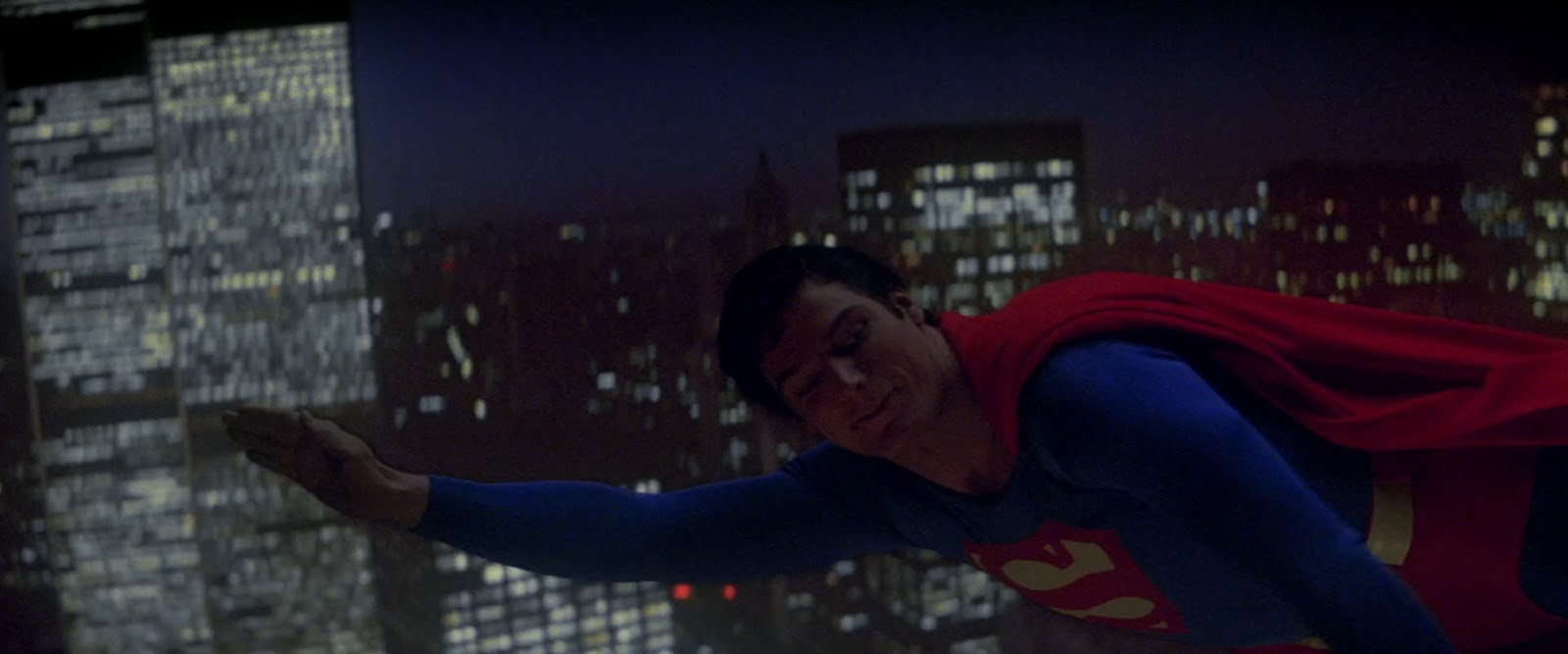
This flying shot from the three-hour cut is a favorite of mine,
but is sadly missing from other editions of the film.

"...
I don't think he wants me to, Mr. Luthor."


I'm probably not alone in admitting I didn't really get Margot Kidder's Lois Lane on my first viewing as a kid. Maybe it was her surface neuroticism that didn't gel with me then, and it probably took actually growing up (and amassing enough comic cynicism to fill Long Lake) for me to warm to her. That's not Kidder's fault, of course, and her Lois's adorkableness goes a long way in sealing the deal for me now. 

Ned Beatty as Otis
Luthor's getup here makes Walter Matthau's in
Pelham One Two Three look subtle by comparison.

Gene Hackman was one of the few actors I actually knew by name (and who actually still did movies) in 2000, so I too was thrown by his portrayal of Lex Luthor. Long used to the post-Crisis, corporate bigwig Luthor, imagine my surprise when the villain of the big, beloved Superman movie was just some brainy know-it-all who smiled way too much for a big, bad villain. Like with Lois, however, it was the personality and inner workings under the surface that bridged the gap between my first and second viewings. Affable as he may be, this Luthor is still a complete sociopath who is more than happy to kill anyone and everyone who even remotely gets in his way.

This scene with Eve and Lex's "babies" is another three-hour cut 
favorite of mine, though it does further confuse why
Eve would return to help Lex and Otis in Superman II.

I had never understood why (aside from materialism) Eve was attracted to Lex. 
The three-hour cut basically answers that question with implications of "the bedroom". 
(Also, note the photo of Hackman's Harry Caul on the right.)

I wonder how Lex felt once he found out Max Zorin basically
stole his evil plan (and yet somehow made it even dumber) in 1985.

But the glue keeping together and informing this film is Richard Donner's direction and Tom Mankiewicz's script (integrating previous drafts by Mario Puzo, Robert Benton, and David and Leslie Newman), the latter of which cleverly inserts more "under the hood" in subtext, irony, and cultural context than could be covered in an article of this size.

In one of the film's many excellent examples, when Superman 
gets Lex Luthor's high-frequency message, Perry White
is in the middle of telling Clark he lacks aggression and confidence.

Seconding Ken Anderson's point about escapism without mindlessness, Superman never strays from the human emotion and personality of the characters, while grounding Metropolis and other settings with enough realism to really believe what we're seeing on the screen. Sure, I love a good, silly, "so bad, it's good" movie like the rest of them (largely for riffing purposes), but when it comes to films like Superman, isn't it always better to have fun and get something innately, viscerally, life-affirmingly satisfying out of it too?

Superman's message and story thrives on its theme of human beings being innately good, and the state of the world being naturally good in turn. That despite all that pose a danger in the world, Superman will be there to avert disaster.

Which makes it all the more a gut punch when he fails to save the woman he loves.

Even six-year-old me was taken aback by Superman
actually going there, even after all that buildup beforehand.

I can only wonder what it was like for audiences in late 1978 - early 1979 watching it for the first time. As much as the tension was building and they saw Lois's car get buried, surely they must have still expected Supes to get there in time.

TIME OUT...

This past year, I've spent my free time writing a screenplay remake adaptation of a 60s romantic comedy, heavily influenced by Superman itself (tone, humor, references, homages, subtext, you name it....) and set in my hometown of Nanaimo. Similar to what the above scene in Superman does, while still ending up playing the genre straight, there's still a subversion of expectations, (partially or wholly) deconstructing tropes that would be seen as either tired, dated, or cliched today.

Also, my town has a Superman and Wonder Woman mural at a street named Lois Lane. How could I not include that?

Nanaimo Urban Art Gallery mural by Lys Glassford

AND NOW, BACK TO THE ENDING...

Ultimately it's the affirmation from his adoptive father that spurs Superman to do what he does to save Lois. While the mechanics of it would give anyone a headache, the film plays it seriously and grounded enough that it doesn't kill the film for most people, and certainly not for me. Hell, I didn't even mind it when Superman II: The Richard Donner Cut reused it for their ending, though that might have been because Perry White wears what has to be the single most ugliest bathrobe ever.

Also, who the hell smokes a cigar while brushing their teeth?
(Although, knowing Perry White, it's probably the other way around.)

Also, you are so not Lois Lane! Go away!
(The Unsworth-esque lighting is much appreciated, though.)

Erm... anyway, will I do the Donner Cut for a post in the future? Perhaps, though I don't plan on watching the Richard Lester cut for comparison (as tempting as the third installment of the Sheriff J.W. Pepper saga is).

As for Superman III? Err.. maybe I'll do an "Extended Observations" on that one...

In terms of subtext, Vera Webster is a pop culture 
analyst's dream, and we'll just leave it at that.

LOGO GEMS


Superman and Beyond the Poseidon Adventure (1979) are the only films that simply start with Warner Bros.' "Big W" stopping in the middle of the screen, with merely a "Released By" credit fading in. This is due to Superman being largely financed by producers Pierre Spengler and Alexander and Ilya Salkind themselves.

OTHER (SUPER) OBSERVATIONS (OH COME ON, YOU KNOW I HAD TO...)

The Stuff of (Super) Travelogues: Drumheller, Alberta...

...and Kananaskis Country, Alberta.

My favorite minor character, Frank Lazarus's Air Force One pilot,
is dubbed in the theatrical cut (and that voice makes that scene), 
but his real voice is heard, of course, in the three-hour cut.

Cliff!

Since the three-hour cut reveals that Jimmy's camera had no film,
this shot is rendered hilariously pointless.

The least convincing model in the film, seeing as the boulders basically bounce 
into the water. Suddenly I'm wondering, was Moonraker really worth it?

Lois's "Can You Read My Mind?" monologue used to feel so out of place
to me, but now its corny charm has quite grown on me.

This. 
Everything about this scene. 
This this this. I absolutely love it.

TIDBITS AND SUCH


Nanaimo's historical Cassidy Pub, which was used for exteriors in Man of Steel, burnt down in 2016 after it was deemed a hazard and ordered to be demolished. 

Read Ken Anderson's Superman essay here. (Oh, to have been an audience member in 1978!)

Watch Bob Chipman's "Really That Good" episode on Superman here.

And if you're late to the fandom like me, the Caped Wonder fansite is the best you'll find online. 

Nanaimo Urban Art Gallery mural by Lys Glassford

Looking back on Superman now, at this point in time, it's indeed difficult to separate all the things that I've taken into my own writing, from the things that resonated with me as a viewer that second time. Perhaps, ultimately, these two categories were never meant to be separated at all.


Copyright © Chynna Moore