Showing posts with label Dick O'Neill. Show all posts

December 20, 2020

THE FRONT PAGE (1974)

Billy Wilder's remake of Charles MacArthur and Ben Hecht's 1928 play occupies a snug but odd place in the filmographies of all those in it. A snapshot of the differing states of the careers of its actors, crew, and writers, if you will. Already brought to the screen (slightly censored from the stage version) in 1931 and again in 1940 as His Girl Friday, the story struck again while the iron was hot in the wake of Watergate and a slew of films themed around the era's paranoia. That, coupled with the wave of nostalgia films also ubiquitous for the rest of the decade (Paper Moon, The Great Gatsby, The Sting), likely spurred Universal to throw their newsboy cap into the ring as well.

Jack Lemmon as Hildy Johnson

Walter Matthau as Walter Burns

Susan Sarandon as Peggy Grant

Austin Pendleton as Earl Williams

Vincent Gardenia (center) as Sheriff "Honest Pete" Hartman

Adapted by Wilder's main scribe I.A.L. Diamond, TFP takes advantage of a great cast, relaxed 70s standards, and timely source material to produce an admirable if ultimately mixed result.

Above: the only weather-related indication that the film takes place in June.

Indeed, a fundamental flaw that is soon noticed with TFP is its timing, pacing, and relative lack of tightness in its energy and direction. Wilder seemingly aims for lines of dialogue to simply not overlap, which is often doom for a fast-paced satire.

After the film's excellent opening credits, it loses considerable momentum
once we see the press room and the competing newsmen in it.

On the upside, Lemmon and Matthau are great together, and Diamond's screenplay rightfully expands Matthau's role and accommodates their winning chemistry. The factors of the source material's dialogue, Matthau and Lemmon's quicker timing, and far worse outings such as Buddy Buddy and The Odd Couple II have given me a new appreciation of this film on recent rewatches.

Pendleton said years later that Matthau and Lemmon didn't 
get along with Wilder over their conflicting approaches to the film. 
Tellingly, it's this portion of the film that seemingly has the most energy.

Gardenia is a standout, easily matching Matthau and Lemmon's energy
and making for a fun, blustery villain (relatively speaking).

Pendleton also fares well, adding a much-needed sweetness to the proceedings.

Make no mistake, TFP is not a long film (it's barely over an hour and forty minutes), but it can feel that way at times, especially in the first half. Perhaps Wilder was better off just allowing Matthau, Lemmon, and others to pick up the pace and inherent manic energy characteristic of the profession being satirized. 

THE ROLE OF ADAPTATION 

Diamond's script adds several new characters while removing several others, such as Hildy's future mother-in-law who Walter kidnaps (as hilarious as Matthau's Walter doing this would be).

Jon Korkes as Rudy Keppler
One of the best additions to this version, as it allows Walter to basically
troll Hildy from offscreen and emphasize Hildy's professional ego.

But the best immediate result of Diamond's adaptation is the expansion of Walter Burns' screentime, unsurprising given Matthau's star power and excellent casting.

I love how Walter just appears in the room here, a la Buddy Love.

The downside comes as a result of the aforementioned looser standards in language, as while Deliberate Values Dissonance is definitely in play here, the mentions of "f*ggot" and other words not in the original play come off as jarring and even a little cheap, especially given how characters already use terms like "red" and "pinko", (but not harsher versions of those words) in the period slang context. 

And that's before getting into the cringey implied actions (to Keppler)
of newsman Bensinger (David Wayne).


Diamond does a decent job adding events and action outside of the press room
setting, including this (visibly) sped-up chase of squad cars rushing to 
various alerts of Williams' whereabouts.

THE STUFF OF SLATES (AND THE REST...)

Wilder and Co. put together a stellar supporting cast for TFP. Loaded with character actors, Wilder regulars, and "before they were big"s, TFP's roster includes but is not limited to...

Herb Edelman (Stan on The Golden Girls and Murray in The Odd Couple (1968))
as Schwartz and Allen Garfield (Nashville, Beverly Hills Cop II) as Kruger

Charles Durning (Tootsie, The Muppet Movie, Peter Griffin's dad) as Murphy

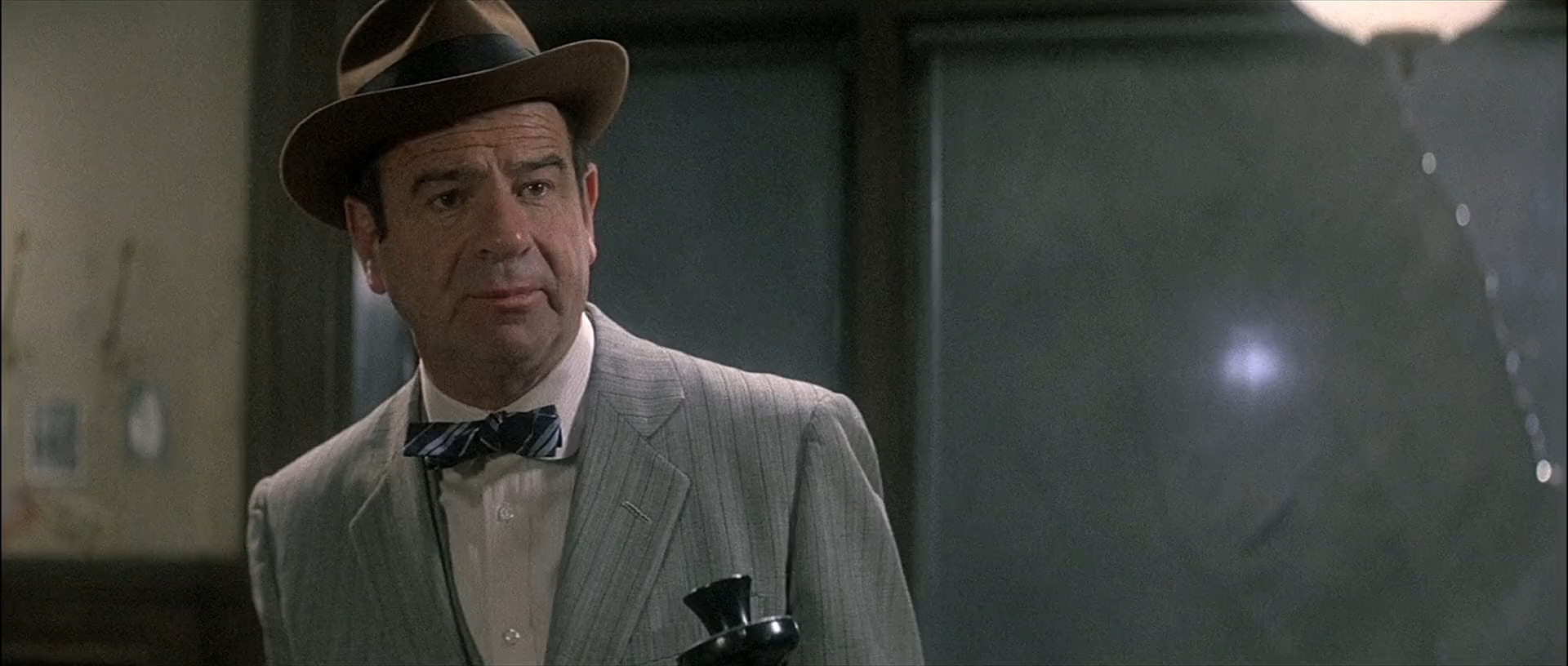
Dick O'Neill (who costarred with Matthau that year in The Taking of Pelham One Two Three) as McHugh

Cliff Osmond (another Wilder regular) as Officer Jacobi, who was only mentioned in the play.

Harold Gould as the Mayor 

Paul Benedict (Mr. Bentley on The Jeffersons) as Plunkett

THE REDHEAD IN THE ROOM...

Carol Burnett as Mollie Malloy

In the grand scheme of things, while not terrible at first, Burnett's portrayal of TFP's moral center is tonally mismatched to the rest of the film. My first viewing wasn't helped by having previously seen 1972's Pete 'n' Tillie, so imagine the whiplash seeing and hearing Burnett's pitched-too-high performance, almost diametrically opposed to the actors around her. 

Some time after the film's release, after it was shown as an in-flight movie on a flight she was on, Burnett stood up, went on the attendants' P.A. system, and apologized to her fellow passengers for what they had just witnessed, to great applause.

THE STUFF OF PLATES

Despite its flaws, I've found myself coming back to TFP time and time again for its period detail, cinematography (by Jordan Cronenweth), lighting, and atmosphere. It's not a far cry from other period films of the 70s, but its setting and somewhat-claustrophobic feel (for its 2.39:1 aspect ratio) reminds me of rainy winter nights at home rather than Chicago in the summertime (which you'd think would be hotter than seen in the film, but who knows).


1974: A banner year for trains, fog, and white lights.

OTHER OBSERVATIONS

You know it's 1974 when the (intentionally) bland girlfriend is played by
Susan Freaking Sarandon, of all people.

The original Stormtrooper Aim.

Still shorter than the wait for Rex Kramer.

TIDBITS AND SUCH


TFP would later find itself featured (albeit with its clips out of order) in 2019's Dolemite is My Name (a film I highly recommend). It says something about TFP's place in film history when its most prominent appearance has it being lambasted by the main characters.


Like with its cinematography, another visual aspect of TFP that stuck with me was its great posters (U.S. and Japanese ones above). Given the amount that survives today in the form of posters, lobby cards, and foreign release materials, Universal seemed to have been gunning for a massive hit that ultimately fell a bit short.


The Front Page has found a new audience on DVD and Blu-ray, and while it's not deserving of being a mere footnote, its overall result leaves much to be desired, given its league of talent.


Copyright © Chynna Moore

January 12, 2020

THE TAKING OF PELHAM ONE TWO THREE (1974)


Thrillers that defined and preserved the 1970s for future generations could, for most people, be counted on one hand: Dirty Harry, The French Connection, Death Wish, The ConversationAll the President's Men (and one could maybe make a case for Klute and Three Days of the Condor). 

But one film often left out is one that isn't as well-remembered on a count of its main characters or the cultural zeitgeist it tapped into, but rather its premise, setup, and execution. In that respect, it's likely the same reason why my 70s-obsessed self never got to it earlier. Yes, folks, as of 2019, consider me late to the Taking of Pelham One Two Three party.

Walter Matthau as Lt. Zachary Garber

Robert Shaw as Mr. Blue

Hector Elizondo as Mr. Grey

Earl Hindman (Yes, Wilson) as Mr. Brown

Martin Balsam as Mr. Green

On an ordinary day in Beame-era New York, a color-coded group of armed men take 18 passengers of the Pelham 1:23 subway car hostage for (Dr. Evil-style pinkie to mouth) one million dollars. 

Dick O'Neill as Frank Correll
O'Neill co-starred with Matthau in The Front Page that same year.

Jerry Stiller as Lt. Rico Patrone

Peter Stone (adapting the novel by Morton Freedgood (pen name John Godey)) does again what he did so well with Charade (1963). A lean, mean (but not mean-spirited) thriller, Pelham smartly rides through its darker, dangerous elements with an undercurrent of wry humor that keeps it all from getting bogged down. Taking that and the use of telephones/walkie-talkies into account, it occurs to me that Die Hard owes a lot more to this film than I ever thought before.

Pelham's hostages, all from different backgrounds, are memorable, 
likable, and pull together to try and help each other.

Matthau's stepdaughter Lucy Saroyan plays a hostage.

Perhaps the word "undercurrent" is too mild when describing Pelham's humor. Almost everyone in this film gives as good as they get in the snark department.

Well, except these guys, but their last lines are so good that I won't spoil them here.
(They're played by Sho Onodera, Toru Nagai, Conrad Yama, and Tura Nakamura respectively.)

The key here, of course, is contrast. Because while the hero and most of the other characters are cinematic New Yorkers through and through, the main villain is a cool, calm, measured Englishman who's willing to fulfill his plan by any means necessary.

Never raising his voice (except at Mr. Grey), Mr. Blue's
cold demeanor suggests he's a professional long before
bits of dialogue reveal his past.

Not to join the chorus, but yes, that yellow tie certainly is a look.

Despite having less screentime than many of his other well-known films, Matthau's Garber still has his star quality written all over him. Seemingly the only worker in his area concerned for the hostages' safety (a sentiment even the mayor doesn't share), he's arguably the closest thing the movie has to a moral compass, chiefly keeping the film from becoming too cynical and downbeat. The quips he makes to the criminals certainly help too.

Like Columbo, Garber's rough edges hide an officer who's 
damn good at his job and an intellectual match for the villain.

Pelham is also a great example of showing us characters without backstories to inform their personalities. Now as a screenwriter, I'm not against backstories on principle, if they are worked into the story organically and are thematically relevant. But sometimes, in a keep-it-moving thriller whose backbone is in its premise and how the villains' plan will unfold, you have to be economical. Basically, to quote 1996's Scream: "[I]t's a lot more scarier when there's no motive".

Unlike the 2009 film, Bernard Ryder gives us his personality
in his behavior, (relative) etiquette, and interactions 
without the need for a full backstory.

Over the course of the film, we do get pieces regarding the pasts of the gang. Interestingly, one bit left out of the film altogether is the novel's stated cause of Mr. Grey's ejection from the Mafia: Running a protection racket, he still beat up those under protection even when they paid, thus deeming him bad for business.

Out of the four villains, Mr. Brown unfortunately gets short shrift due 
to his role and his place in the subway car

However, the difference with this film is that these bits are worked in naturally, i.e. conversations between Mr. Blue and the inexperienced Mr. Green, to break up the scene's tension if need be.

It was actually difficult for me to get screencaps of the gang, 
as the film is quite darkly lit at times.

Despite being a masterclass in thrills, tension, and clashing personalities, Pelham runs little more than an hour and 40 minutes and doesn't waste a beat. And that ending shot! (No, I won't post it here. Most of you know what it is already.)

AND THE REST...

James Broderick (Matthew's father) as Denny Doyle, 
Mr. Blue's first hostage.

Lee Wallace as the Mayor, 15 years before he was Gotham's 
mayor in Batman, and three years before lookalike 
Ed Koch took the NYC mayor's office in real life.

Tony Roberts (no relation to Doris) as Deputy Mayor Warren LaSalle.

Doris Roberts (who also appeared in 1971's A New Leaf)
as the Mayor's wife Jessie.

Kenneth McMillan as Borough Commander Harry

Beatrice Winde as new NTA hire Mrs. Jenkins

Julius Harris as Inspector Daniels
Years ago, when I saw Pete 'n' Tillie (1972), a train compartment scene made me 
wish Live and Let Die's Tee Hee would show up and try and kick Matthau's ass.
So imagine my surprise when Tee Hee himself shows up and 
speeds down the NYC streets with Matthau in tow.

TIDBITS AND SUCH

There are 70s thriller scores, and then there is David Shire's masterpiece of brass and percussion that is and deserves a category all its own. 


The Japanese poster adapts the original US poster, adding a neat image of the subway route as well as the train silhouette in the corner. I'm not a fan of the red title font, however, which seems to make the film out to be a horror movie. Surely the original yellow font (or a brick-brown version of it) would have sufficed.


And I just had to share this hilariously inaccurate Italian poster. Not only does Garber never fire his gun in the actual film (nor does Mr. Green ever wear that outfit, let alone look this trigger-happy), but when the actual hell did Doyle Lonnegan make a return appearance?


Copyright © Chynna Moore