Showing posts with label 70s. Show all posts

December 20, 2020

THE FRONT PAGE (1974)

Billy Wilder's remake of Charles MacArthur and Ben Hecht's 1928 play occupies a snug but odd place in the filmographies of all those in it. A snapshot of the differing states of the careers of its actors, crew, and writers, if you will. Already brought to the screen (slightly censored from the stage version) in 1931 and again in 1940 as His Girl Friday, the story struck again while the iron was hot in the wake of Watergate and a slew of films themed around the era's paranoia. That, coupled with the wave of nostalgia films also ubiquitous for the rest of the decade (Paper Moon, The Great Gatsby, The Sting), likely spurred Universal to throw their newsboy cap into the ring as well.

Jack Lemmon as Hildy Johnson

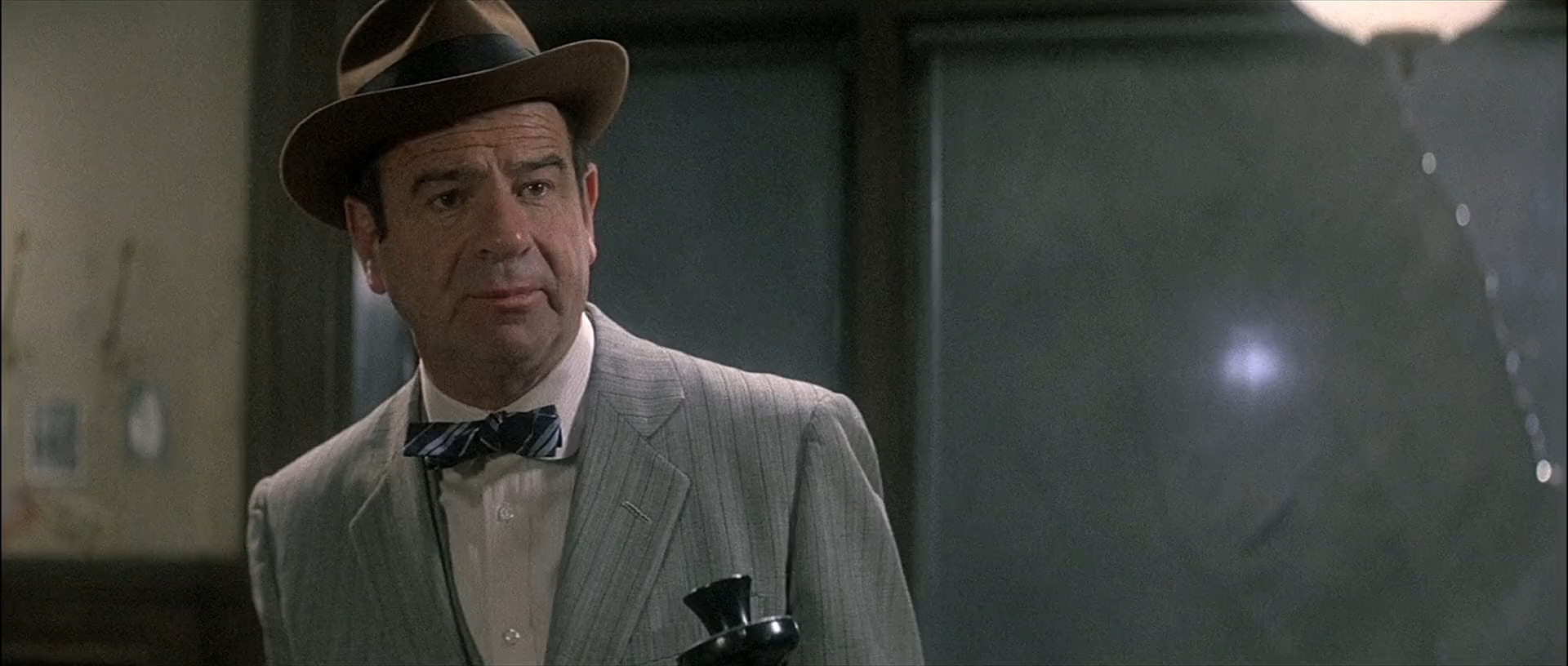
Walter Matthau as Walter Burns

Susan Sarandon as Peggy Grant

Austin Pendleton as Earl Williams

Vincent Gardenia (center) as Sheriff "Honest Pete" Hartman

Adapted by Wilder's main scribe I.A.L. Diamond, TFP takes advantage of a great cast, relaxed 70s standards, and timely source material to produce an admirable if ultimately mixed result.

Above: the only weather-related indication that the film takes place in June.

Indeed, a fundamental flaw that is soon noticed with TFP is its timing, pacing, and relative lack of tightness in its energy and direction. Wilder seemingly aims for lines of dialogue to simply not overlap, which is often doom for a fast-paced satire.

After the film's excellent opening credits, it loses considerable momentum
once we see the press room and the competing newsmen in it.

On the upside, Lemmon and Matthau are great together, and Diamond's screenplay rightfully expands Matthau's role and accommodates their winning chemistry. The factors of the source material's dialogue, Matthau and Lemmon's quicker timing, and far worse outings such as Buddy Buddy and The Odd Couple II have given me a new appreciation of this film on recent rewatches.

Pendleton said years later that Matthau and Lemmon didn't 
get along with Wilder over their conflicting approaches to the film. 
Tellingly, it's this portion of the film that seemingly has the most energy.

Gardenia is a standout, easily matching Matthau and Lemmon's energy
and making for a fun, blustery villain (relatively speaking).

Pendleton also fares well, adding a much-needed sweetness to the proceedings.

Make no mistake, TFP is not a long film (it's barely over an hour and forty minutes), but it can feel that way at times, especially in the first half. Perhaps Wilder was better off just allowing Matthau, Lemmon, and others to pick up the pace and inherent manic energy characteristic of the profession being satirized. 

THE ROLE OF ADAPTATION 

Diamond's script adds several new characters while removing several others, such as Hildy's future mother-in-law who Walter kidnaps (as hilarious as Matthau's Walter doing this would be).

Jon Korkes as Rudy Keppler
One of the best additions to this version, as it allows Walter to basically
troll Hildy from offscreen and emphasize Hildy's professional ego.

But the best immediate result of Diamond's adaptation is the expansion of Walter Burns' screentime, unsurprising given Matthau's star power and excellent casting.

I love how Walter just appears in the room here, a la Buddy Love.

The downside comes as a result of the aforementioned looser standards in language, as while Deliberate Values Dissonance is definitely in play here, the mentions of "f*ggot" and other words not in the original play come off as jarring and even a little cheap, especially given how characters already use terms like "red" and "pinko", (but not harsher versions of those words) in the period slang context. 

And that's before getting into the cringey implied actions (to Keppler)
of newsman Bensinger (David Wayne).


Diamond does a decent job adding events and action outside of the press room
setting, including this (visibly) sped-up chase of squad cars rushing to 
various alerts of Williams' whereabouts.

THE STUFF OF SLATES (AND THE REST...)

Wilder and Co. put together a stellar supporting cast for TFP. Loaded with character actors, Wilder regulars, and "before they were big"s, TFP's roster includes but is not limited to...

Herb Edelman (Stan on The Golden Girls and Murray in The Odd Couple (1968))
as Schwartz and Allen Garfield (Nashville, Beverly Hills Cop II) as Kruger

Charles Durning (Tootsie, The Muppet Movie, Peter Griffin's dad) as Murphy

Dick O'Neill (who costarred with Matthau that year in The Taking of Pelham One Two Three) as McHugh

Cliff Osmond (another Wilder regular) as Officer Jacobi, who was only mentioned in the play.

Harold Gould as the Mayor 

Paul Benedict (Mr. Bentley on The Jeffersons) as Plunkett

THE REDHEAD IN THE ROOM...

Carol Burnett as Mollie Malloy

In the grand scheme of things, while not terrible at first, Burnett's portrayal of TFP's moral center is tonally mismatched to the rest of the film. My first viewing wasn't helped by having previously seen 1972's Pete 'n' Tillie, so imagine the whiplash seeing and hearing Burnett's pitched-too-high performance, almost diametrically opposed to the actors around her. 

Some time after the film's release, after it was shown as an in-flight movie on a flight she was on, Burnett stood up, went on the attendants' P.A. system, and apologized to her fellow passengers for what they had just witnessed, to great applause.

THE STUFF OF PLATES

Despite its flaws, I've found myself coming back to TFP time and time again for its period detail, cinematography (by Jordan Cronenweth), lighting, and atmosphere. It's not a far cry from other period films of the 70s, but its setting and somewhat-claustrophobic feel (for its 2.39:1 aspect ratio) reminds me of rainy winter nights at home rather than Chicago in the summertime (which you'd think would be hotter than seen in the film, but who knows).


1974: A banner year for trains, fog, and white lights.

OTHER OBSERVATIONS

You know it's 1974 when the (intentionally) bland girlfriend is played by
Susan Freaking Sarandon, of all people.

The original Stormtrooper Aim.

Still shorter than the wait for Rex Kramer.

TIDBITS AND SUCH


TFP would later find itself featured (albeit with its clips out of order) in 2019's Dolemite is My Name (a film I highly recommend). It says something about TFP's place in film history when its most prominent appearance has it being lambasted by the main characters.


Like with its cinematography, another visual aspect of TFP that stuck with me was its great posters (U.S. and Japanese ones above). Given the amount that survives today in the form of posters, lobby cards, and foreign release materials, Universal seemed to have been gunning for a massive hit that ultimately fell a bit short.


The Front Page has found a new audience on DVD and Blu-ray, and while it's not deserving of being a mere footnote, its overall result leaves much to be desired, given its league of talent.


Copyright © Chynna Moore

April 1, 2020

BAFFLED! (1972)


The fall of 2009 saw my sixteen-year-old self battle two bad colds twice in one month, and in all my online time, the bulk of it was spent exploring the non-Star Trek filmography of one Leonard Nimoy. So imagine my reaction when I came upon the opening of Baffled!, in all its cheesy, funky glory.

Distilled in one frame: 
The borderline-self-parody within this movie.

A failed T.V. pilot repackaged into a "second-feature" U.K. cinema release and a T.V. movie stateside*, Baffled! is a cultural artifact too "dime a dozen" to be a total weirdfest, but too absurd to be totally forgotten.

Leonard Nimoy as Tom Kovack

Susan Hampshire as Michele Brent

Vera Miles as Andrea Glenn

Jewel Blanch as Jennifer Glenn

Valerie Taylor (in her last film appearance)
as Louise Sanford

Rachel Roberts as Mrs. Farraday

Christopher Benjamin as Signor Verelli

Ray Brooks and Angharad Rees 
as George and Peggy Tracewell

American racecar driver Tom Kovack (Nimoy) crashes his car after seeing a terrifying vision involving movie star Andrea Glenn (Miles), her daughter Jennifer (Blanch), and a stately manor in North Devon, England. 

Dig that desk driving!

That's So Nimoy

With the help of ESP expert Michele Brent (Hampshire), the two set off for North Devon, in hopes of heading off the imminent danger seen by Tom, only to get tangled in a villainous plot to gaslight Andrea through her vulnerable daughter.

Insert Psycho II joke here.

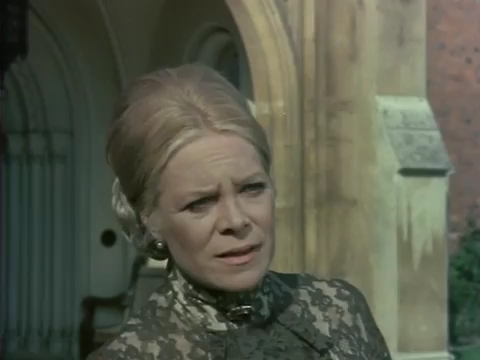
Baffled! is a mish-mash, to say the least. A cheesy, absurd, yet oddly staid and "seen them all", it's clear to see why it didn't get picked up for a full series, but is still, well, "fascinating" to watch in seeing how transitional early-70s television really was.


A tip-off to Baffled!'s T.V. origins:
Michele merely sees Tom detailing his vision on T.V.

While I can certainly appreciate Baffled!'s mostly-brisk pace and not-idiotic characters (especially given that fate-tempting title), its bad effects, cliched score, and cheesy dramatics at times will leave you wondering just how much of it is meant to be taken seriously. And that's not even getting into its Dolemite-esque, spoiler-iffic opening credits.

Baffled!: Spoiling one-twelfth of the solution to
Murder on the Orient Express since 1972.

Perhaps Baffled! would have fared better with a more potent pairing at the center of its plot, but as is, Nimoy and Hampshire are more believable to me as friends than "will-they-or-won't-they".

Refreshingly, Tom and Michele get along fine, without
the vitriol that taints many fictional pairings today,
though it's still at the expense of interesting interplay.


While Tom is written as a slightly smarmy, "prettyboy" type, Nimoy is more than a bit miscast in the role. Much as he tries, you'll wince a bit when he calls Hampshire "a great lookin' chick". I hate to say it, but in a role like this, William Shatner could probably play it in his sleep (not to mention up the cheese factor considerably).

Naturally, Nimoy fits his role best when Tom
has to investigate on his own.

Roberts, on the other hand, is so obviously the villain that she's one of the more enjoyable aspects of Baffled!, even if she gets a bit short shrift (especially in the U.K. cut*).


Roberts brings out her inner Eileen Brennan.


Another point in Baffled!'s favor is Blanch's performance as Jennifer, which mercifully avoids the overwrought hamminess common for child actors in the 60s and 70s. Blanch is just calm and laid-back enough for Jennifer's change in behavior to be that little bit unsettling.

Yep. Totally normal.

An iron-clad sign that Jennifer is acting weird? Tom and Michele notice her 
going from dresses and pigtails to blouses and bell bottoms. 
(Also, how did she get the latter clothes?)

Baffled!'s script comes off as two forces wanting different things from the same premise, despite having only one credited writer (Theodore Apstein, who also wrote the screenplay for What Ever Happened to Aunt Alice? (1969)). Dialogue seemingly switches between perfectly self-aware and cheesy and melodramatic (not helped by the score), and several plot holes rear their ugly head. As a result, several questions are left unanswered, despite the film's plot itself actually being pretty easy to follow.

While a "gathering of suspects" amusingly takes place about 
halfway through the film, no actual solution is revealed here.

Michele makes the mistake of looking inside a black van in a mystery movie.

Baffled! has a fun chase between the black van and Tom's Bentley 3 Litre.

It's the hat that sells it.

Baffled! is the sort of film you imagine late night talk shows spoofing in the mid-to-late-90s as a fictional vehicle for William Shatner or Adam West. Nimoy, however, seems stuck in a thankless role, at least without a needed rewrite to bridge the difference in casting.

(*I've come to realize that my copy of Baffled! is the edited 90-minute U.K. cut, which, aside from reordered opening scenes and a few cut ones, is not substantially different from the 96-minute U.S. cut.)

THE STUFF OF LAUGHTER EFFECTS

What keeps Baffled! memorable for this viewer are the laughably bad effects utilized for Tom's visions and the action sequences. I can't speak for the standards of 70s U.K. television, but if these effects were the best they had, I can't even fathom what the worst of them would be.


Dig that "day for night"!

OTHER OBSERVATIONS

Oh hai, Shane Rimmer!

Jennifer's father (Mike Murray) brings out his inner Kevin McCarthy.

That hat though...

Sorry, I can't hear you over my fabulous hat.

One of Baffled!'s best payoffs is at the end of this elevator sequence.
(Seemingly long as it is.)

No, Nimoy's not about to fight a prepubescent girl.
He's just trying to do this movie's equivalent of a "mind meld", that's all.


I think my work is done here.

Baffled! will likely be a disappointment for Nimoy fans, but as a "so bad, it's good" 70s artifact, it's a fun movie to riff with friends, whether or not they're well-versed in 70s supernatural thrillers.


Copyright © Chynna Moore