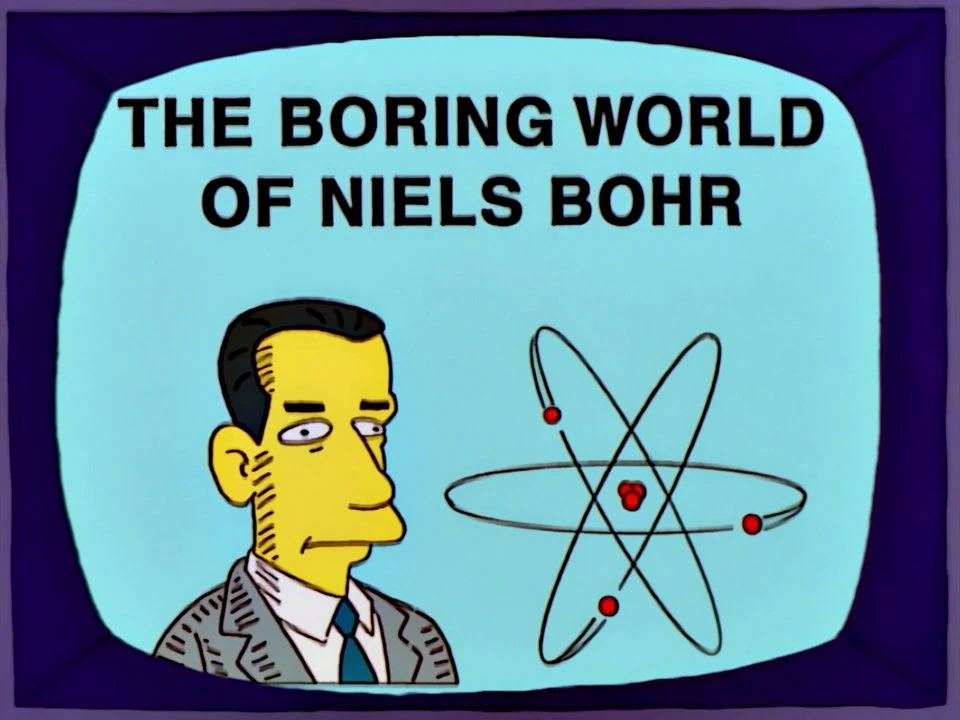
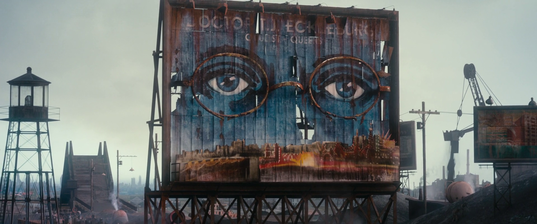
Showing posts with label Valerie Perrine. Show all posts

January 12, 2021

ROOMS IN A VIEW: DECIDING YOUR SETTINGS


It can be easy to take for granted the importance of setting in a scene. Setting, however, is one opportunity of many to deepen the overall story. Here are a few useful pointers to keep this setting from being boring on paper and onscreen.

WHAT IS GOING ON IN THE SCENE? WHO IS IN IT?

Action and plot come first if you're undecided on a setting for your scene, or the setting you currently have just isn't working. Let your eventual setting choice accommodate those first, of course, before deciding on the multitude of factors below.

For Rick Dalton to simply be told what kind of character he's playing on Lancer would be boring. 
In the show's hair and makeup trailer, however, he's confronted with the aesthetic aspects of 
his villainous character as well as those of the currently-popular stars of 1969,
driving home just how "out of time" he truly feels.

WHAT IS THE SPACE?

Is it wide open? Claustrophobic? Old, decrepit? Or new with the plasticky smell still present? What are the sounds? If your scene takes place indoors during the summer, it's likely the A/C will be heard in the background. Outside, you'll likely hear birds and passing cars. Is it a setting that's loose and laid-back? Or uptight and solemn?

Lex Luthor repurposes an abandoned subway station into his lair, which is large and grand
in nature, but still possesses his means of villainy and "hiding in plain sight".

WHAT PROPS WILL BE THERE?

No props would be fine if your scene in question is about two characters merely verbally sparring, but especially in comedies, it's important to remember that props can be your friend. After all, a character's stern point can be undercut by a considerably sillier prop.

This would not be an example of the above.

HOW WILL THEY INFORM YOUR CHARACTERS (AND VICE VERSA)?

Is the setting intrusive enough to affect the characters' conversation? Or so deadly quiet that they feel exceptionally nervous and self-conscious? It may not even influence their conversation directly, but perhaps it's not as secure as they think. Like props, let the room be your friend.

The claustrophobic, bustling courthouse press room in The Front Page (1974) influences
Hildy Johnson's tension in hiding Earl Williams from his fellow press men.

ARE THERE PARALLELS OR THEMATIC CONNECTIONS?

Similar to the above, the room in question can be indicative of a character's personality, past, present, and future. Is it as stifling as their nature? Open and barren? Or just there because the character is barely in there to begin with?

Despite being one of the smaller spaces in Luthor's lair, this map room is spacious, with plenty of room
for Luthor's various computers (because 1978), furniture, and distance between him and
Miss Teschmacher, signifying their opulent, but emotionally cold dynamic.

ARE THEY REAL? FICTIONAL? 

Real locations can be enhanced with regional and other details (see in my "Screenwriting" tag), but a fictional setting can still parody a real one to hilarious effect. What are its further surroundings? Is the larger setting the Mojave desert? Or Churchill, Manitoba with polar bears?

Three words that strike fear into the hearts of animal lovers
and lovesick old folks alike.

Copyright © Chynna Moore

May 20, 2020

RUNNING GAGS, "CHEKHOV'S GUN"S, AND THE RULE OF THREE


When it comes to the smaller "setups and payoffs" of your script, the role of a running gag, "Chekhov's Gun", or the "rule of three" will be dependent on how much of the same or similar thing an audience will allow until they tire of it.

Introduce an important prop (the "Chekhov's Gun") without ever coming back to it later, and your audience will feel shortchanged. Go back to the well of a running gag too often, your audience will become tired and irritated.

You can call him Ray, or you can call him Jay,
he's just a visual aide, folks, that's all he is today.

Among other story factors, here are a few things to think about when implementing your little "repeat touches".

YOU DON'T HAVE TO DRAW LOTS OF ATTENTION TO THEM

A common mistake in writing has to do with a lack of subtlety in learning to weave detail into a story. To combat this, you could conceivably make a running gag out of something very minor, or introduce a "Chekhov's Gun" with even more subtlety than others.

While Rick Dalton is established early on as being handy with a flamethrower,
one could easily miss said flamethrower also being present in Rick's shed on first viewing.

Chekhov's Flamethrower

Good, nuanced screenwriting makes use of more than one sensory level for its details. Don't confine your running gags or "brick jokes" (seemingly-irrelevant gags or details that do have an unexpected callback or payoff) to just dialogue or story events. Audiences may expect certain types of props, jokes, or subjects to be not-so-subtle, so if you need to, don't hesitate to try scaling back your gag in question.


The running (done at least twice) gag of Otis and Eve's "I said that / I said it" back-and-forths 
is stated merely in dialogue, and wasn't very funny in this writer's opinion. 
Tellingly, this repetitive gag was cut entirely for Superman's theatrical cut.

GO WITH YOUR GUT (AND THINK LIKE A VIEWER)

How often will you implement your running gag? Will you adhere to the "rule of three" limit? Or scale back a bit and stop at just two instances? This is where (as if you haven't already) you should think like a moviegoer. Only you will know how this will all fit tonally and with what else your script is going for, but the attention of an audience is admittedly quite fickle. Unless you put a spin on it, writing a fourth instance of a running gag past the rule of three is a massive risk (and even with said spin on it). In the hyper-realistic medium of film, the human attention span has its limits, on both ends of the speed spectrum. Keep in the mind the eye of the viewer.

As of 2007, Homer Simpson has jumped or fallen down Springfield Gorge only
three times, with only the second time immediately following the first.

USE THEM TO BUILD YOUR CHARACTERS

For example, different characters will react differently to the same gag. Character S might react very differently than Character I, or they will give the same answer to two different, yet similar ideas or gags. Ideally, your gags or jokes shouldn't always just be there for the sake of having a joke (and pushing the story forward, important as that is).

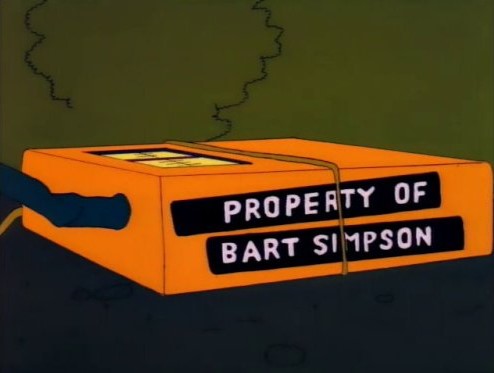
Bart's propensity for labelling everything with his new labelmaker
comes back to bite him in the ass in "Radio Bart".

Leaving aside character humor itself, since the "Chekhov's Gun" definitely needs a payoff and cannot be there for the sake of needing a prop, you could use it towards character as well. Who ends up using the now-important prop? Is it a surprise? Is it part of a twist even? Are they skilled at using it? Terrified of it but forced to use it now? Everything in your script should have a purpose, and ideally more than one purpose.

"I said, hop in."
The reemergence of Mr. Burns' Spruce Moose model plane
caps off his deteriorating mental state in "$pringfield".

DON'T FORGET THE "BAIT AND SWITCH" CARD

This is a good "cheat" to put a new spin on an old gag, or to switch up the third instance of a running gag. Is your running gag a condition or misfortune that is now affecting an unexpected character? Is a last instance of a gag now used in a more serious tone? Is the least likely character presumed to be qualified for a situation actually the most qualified for some absurd, but logical reason? Basically, you should always remember the power of subverting expectations.

The titular "Bart's Comet" breaks up into the size of a chihuahua's head, 
exactly as predicted by (of all characters) Homer.

Running gags and the like are an aspect that will vary considerably and will (or should) be unique to their respective scripts, so hopefully with the above, I've gotten you to really think about how not to overdo a gag or underdevelop a "Chekhov's Gun", in the hopes of keeping your audience invested.

"Oh, dear god, no!"

Copyright © Chynna Moore

February 4, 2020

SCREENWRITING: A FEW MORE TIDBITS


Since my last screenwriting post, I've managed to put into words some more points of consideration in creating and fine-tuning a script. Since a favorite part of mine in this process is the visual aspect, i.e. set design, color, symbolism, character looks, etc., these points relate more to how you can "color" your story through the script process onward.

"STEAL LIKE AN ARTIST "


There is nothing wrong with taking a prior idea or concept and putting your own new spin on it.

So, I have a confession to make: I don't watch movies all the time.

I never go to the theater unless I'm with a friend, and I don't usually seek out a movie unless someone I know recommends it, I come across it reading about something else (rare logos, "cast reunions", etc.), or, in recent years, if I've watched a video review on it and it grabs my further interest.

So how do I bridge that little gap between new visuals and fewer movies?

Well folks, Google Images is your friend.

With just images, even if you know a film's general plot, if you haven't seen the film, a screencap can only tell you so much without its original context. This will make your brain "fill in the gaps", often with a new, different context entirely. So if you love a visual and can "plug it into" your script with a new "connection" to strengthen your story, all the more better.

In Thunderball, Fiona Volpe simply stares at Bond as they dance.
I re-contextualized this in my script as "the girlfriend and boyfriend 
stand up from their table, her staring at him the entire time".

Alternatively, if you have seen a film and want to "borrow" a visual motif or other choice, subversion is also a good method. If black is traditionally seen (in the West) as a "bad" color, while white is seen as "pure" and "good", why not switch that up entirely for your hero and villain?


And that above is really just color theory subversion. Going deeper, if you want to enhance your script's "fish out of water" theme, for example, your protagonist will solidify that by dressing like he stepped out of a Rat Pack movie, while living in a town where most of the men dress in blue jeans, T-shirts, and baseball caps.

Knowing your inspirations this way also speaks to the use of (as stated elsewhere) detail, subtext, themes, and connections. What were they going for? And how will you flip that concept?

GET ON SOME MUSIC

"Put in Cream! Put in Cream!", Martin Scorsese told Mitch Pileggi, when writing Goodfellas' famous scene where Jimmy Conway (Robert De Niro) plans to kill Morrie Kessler.

I don't usually use gifs here, but admit it, you heard
"Sunshine of Your Love" playing just now, didn't you?

All movies, scenes, dialogue, and sequences have a rhythm, but music has the power to transform a dull series of events into an inspired, thematically-enhancing sequence. Even if you choose not to insert songs into your script, music can be an immense help in determining your script's tone, direction, and emotional core. (Nostalgia-wise, this also relates to the heading below.)

Goodfellas also uses music to show the progression of time over the course of its story. From the earlier Crystals and Shangri-Las to the later Cream and Donovan, Scorsese pinpoints the film's eventual emotional dissonance when Donovan's lush, sweeping "Atlantis" plays over the brutal beating of Billy Batts. 

USE YOUR ROOTS


It's another trademark of Scorsese, and it's easy to see why, as he attaches the emotions to his settings as well as details, a move demonstrably invaluable to the medium of film. I can still remember my childhood backyard, with its (steep for a child) downward slope, the smell of cut grass, and the sound of my dad's lawnmower reverberating through the neighborhood. Or your childhood experience of seeing a movie you've grown to love even more as you get older. Positive associations, like your fond past memories and associated nostalgia, can really fuel your passion for your story and your script.

SAVE ALL OF YOUR IDEAS


No matter how seemingly-insignificant a quote, joke, character look, or image might seem, you should still lock it away for future use. Or better yet, you could later adapt them differently from what you originally intended, "stealing from yourself" in a way. 

TRY FOR MORE OBSCURE INSPIRATIONS

No, not for hipster points, but if you're aiming for originality, it's imperative to not only be always taking in new content, concepts, media, etc. but also to do so from works that are less remembered, i.e. films that have fallen into obscurity, but have since gained a new life on Blu-ray and DVD-R releases.

McQ, while seen as a lesser entry in its genre and era, still features several twists 
in its story, and having John Wayne as its star brings up many cultural points 
of discussion, i.e. the thematic similarities between crime films and westerns.

That's not to say more popular fare can't yield any new ideas, but a few new wells to draw from never hurts, especially in the internet age.

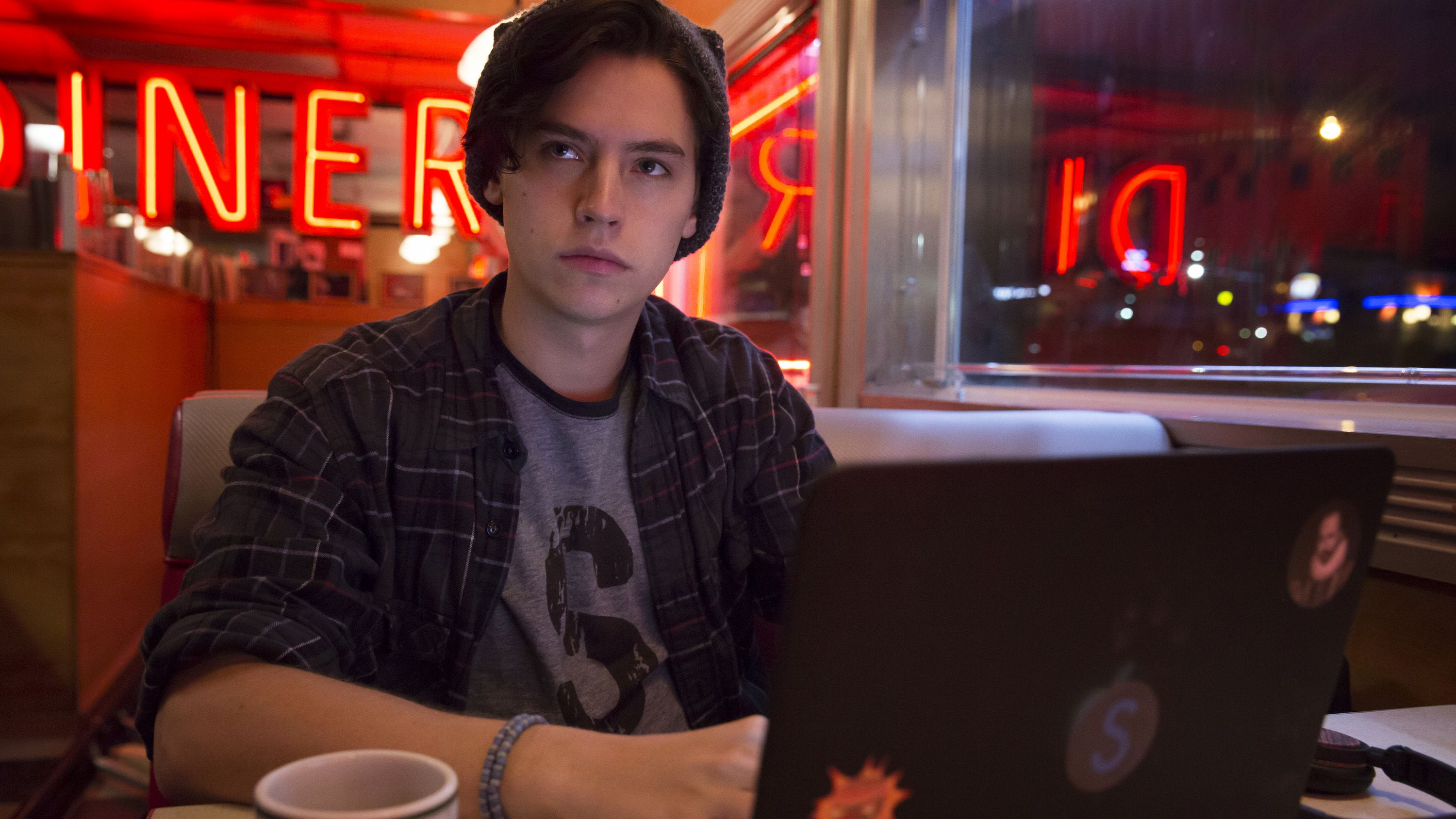
After all, you don't want to solely reference works that are
so entrenched in pop culture, but are still "too old" for
the kids to know. (Sorry, Season One Jughead.)

To make it easier, try and go for works that star actors (or other talent) you already know and love. After all, you just might come up with a Canadianized First Monday in October, where the protagonists are both female and the older, more experienced one is also the Chief Justice. 

Yes, the latter has happened here.
(That's former Chief Justice Beverley McLachlin in the middle, by the way.)

This is especially potent if a "bad" or "mediocre" film has a sliver of pathos, creativity, subverted expectations, or a sentiment "ahead of its time" that's surrounded by otherwise dated, botched, or cringey material. You never know when your viewing of Bloodline might yield you some new creative sparks (even if only to pass the runtime).

Seriously, who wouldn't want to see a movie about a
lovable inspector who converses with a talking computer?

At least it would have better editing, that's for sure.

CONNECT EVERYTHING

So you've completed your first draft, the "skeleton" of your script. You might even have an idea of what "shading" you want to have. (Provided, of course, you have the time.) 

Now, this is the time to think over and reflect on the choices you've made in your script. How will you enhance them on an emotional level? What visual symbols will be around certain characters? What other works can you reference that are thematically similar to your own story? What dynamics in these other works are similar to the ones you yourself created?

Rick Dalton and Easy Breezy. That is all.

An important thing to remember is that you should ideally go all the way down to the last detail. Similar to my last screenwriting post's "Subtext" section, this attention will show your effort and love for your work in a deeply satisfying way. 

For example, if your "lovable a-hole" protagonist is watching something on T.V., make the connection and have him be watching a film or show featuring a similar character. This move also works double-duty in making thematic connections, while keeping obvious stated references out of your dialogue. 

(I will say, however, that this particular example runs the risk of "referencing a better movie during your own", so you should probably go with a more obscure work, as the previous heading discussed.)

Perfect!

This will take some practice, especially in terms of keeping subtlety, and every script will be different. How prominent will a symbol be shown? How prominent is it to the characters? Is your visual metaphor too obvious, and if so, how much should you de-emphasize it? Will you use it to subvert expectations instead?

Yah, no. This one's as obvious as a brick wall.

Will your song choices be on-the-nose? Or more abstract? Will it provide dissonance in your scene, or foreshadow things to come? 

This one, even more so.

In short, everything in your script, story, and concept should work to service your characters, atmosphere, setting, emotion, and payoff. If your inspiration(s) has brought you enough confidence and spark to finish your script, then chances are, it will be the gift that keeps on giving in bringing you new ideas to strengthen and visualize your story. 

So forgive me if the points I've made have overlapped a lot, but with so many ways to go in the visual language of film, hopefully, they have gotten you to think about how your script is (and should be) more than just a standalone series of events. 


Copyright © Chynna Moore

January 26, 2020

SUPERMAN (1978)


In the summer of 2000, the same time my then-five-year-old brother tried to make lemonade with concentrated orange juice and hot sauce, he, my nearly-seven-year-old self, and our parents took one of our many trips to Tri-Star Video on Nanaimo's Bruce Avenue. I haven't the faintest memory what VHS tape I picked, but my brother's choice was Richard Donner's 1978 landmark.

Christopher Reeve as Superman...

...a.k.a. Clark Kent

Margot Kidder as Lois Lane

Jackie Cooper as Perry White

Marc McClure as Jimmy Olsen

Glenn Ford and Phyllis Thaxter
as Jonathan and Martha Kent

Marlon Brando as Jor-El

Jeff East as Young Clark Kent
Though he's dubbed by Reeve in the theatrical cut, 
East's voice can be heard at points in the three-hour T.V. cut.

Gene Hackman as Lex Luthor

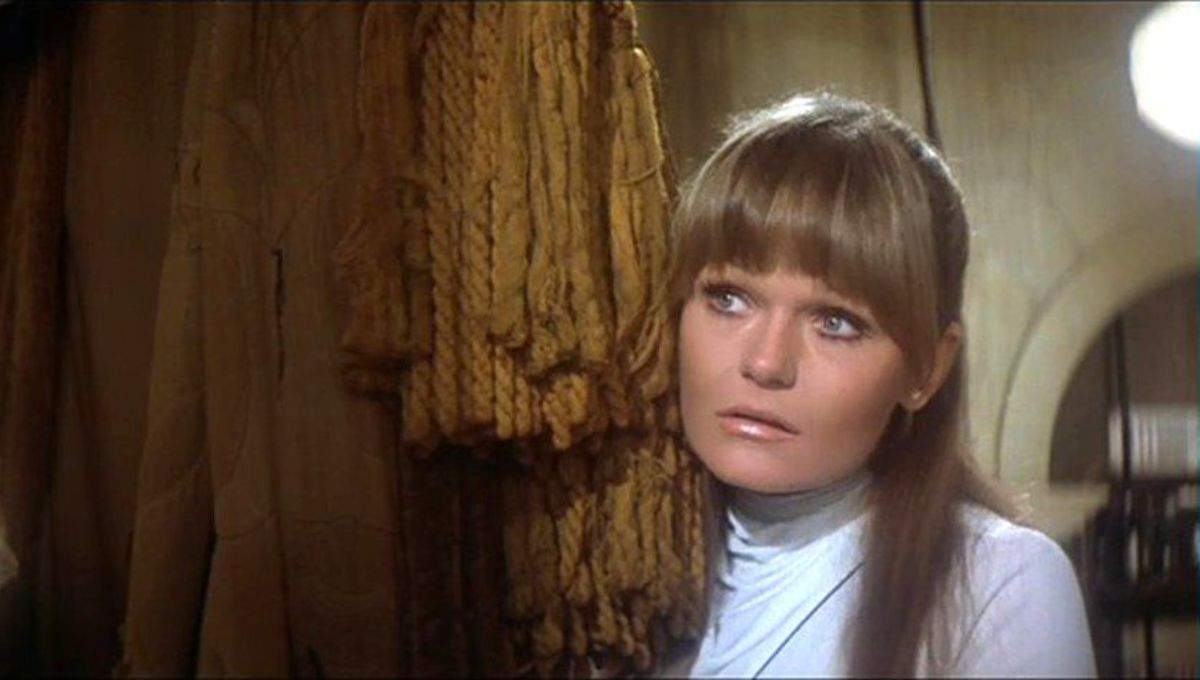
Valerie Perrine as Eve Teschmacher

Even at my young age, while not grasping the littler story beats or character humor, the images of Krypton being destroyed, young Kal-El lifting the Kents' truck, Jonathan Kent's death, Superman finding Lois's body, or him spinning back the Earth left indelible impressions even back then.

Between then and early 2018, however, I didn't think back to Superman much, if at all. Not being a superhero fan in general, I certainly didn't intentionally avoid seeing Superman again, but additionally, none of the newer incarnations stuck out to me as worth seeing on a story or cinematic level, especially given how most of them tried ever-so-hard to avoid comparisons to the Donner films.

But funny enough, it was Bob Chipman's "Really That Good" episode on this film that really encouraged me to give it another look. Superman's more-needed-as-ever message of "something to believe in again" resonated not only due to the time, but also my own situation regarding my father, who was more in than out of hospital with both pancreatic cancer and the side effects of chemotherapy.
Without getting into the long of it, after he had passed from tumor-related sepsis a couple months later, it was this film that was one of the things that helped me though the (for me, short, but certainly emotional) grieving process. After all, it was after Jonathan Kent's death that Clark Kent left the Fortress of Solitude to go to Metropolis and be his best self.

Bank the wall, Supes, bank the wall...

Bank the wall, Supes...

Yes!

But getting back to the film, while I never not believed Christopher Reeve was Superman that first viewing, I completely missed back then how damn good he is in the role. Not to repeat Bob Chipman's assessment, but even if a better Superman film is eventually made, we might never get a better Supes than Reeve. Off-the-charts charm, this Superman has.

Seriously, I'm gay as hell, and even I'm practically swooning right now.

Reeve so completely sells being the "Big Blue Boy Scout",
brimming with pure earnestness rather than being over-the-top.
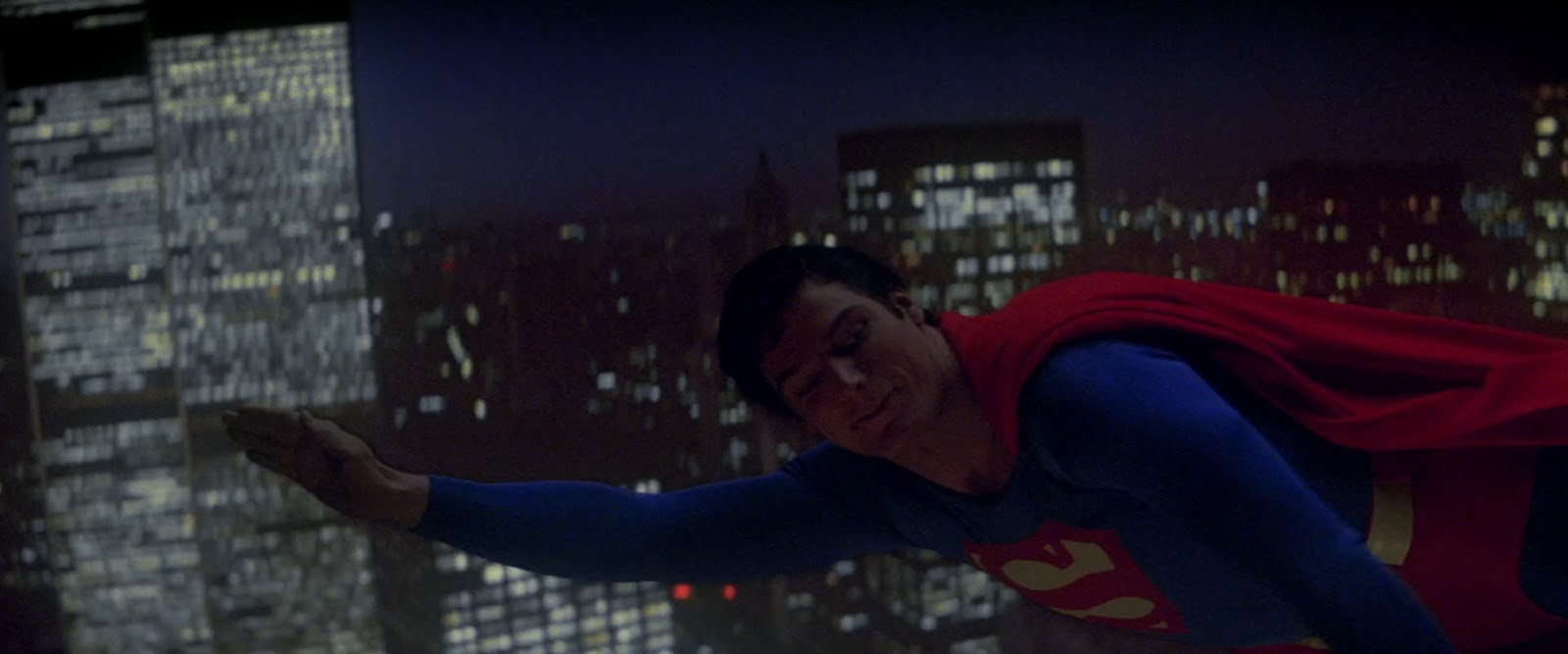
This flying shot from the three-hour cut is a favorite of mine,
but is sadly missing from other editions of the film.

"...
I don't think he wants me to, Mr. Luthor."


I'm probably not alone in admitting I didn't really get Margot Kidder's Lois Lane on my first viewing as a kid. Maybe it was her surface neuroticism that didn't gel with me then, and it probably took actually growing up (and amassing enough comic cynicism to fill Long Lake) for me to warm to her. That's not Kidder's fault, of course, and her Lois's adorkableness goes a long way in sealing the deal for me now. 

Ned Beatty as Otis
Luthor's getup here makes Walter Matthau's in
Pelham One Two Three look subtle by comparison.

Gene Hackman was one of the few actors I actually knew by name (and who actually still did movies) in 2000, so I too was thrown by his portrayal of Lex Luthor. Long used to the post-Crisis, corporate bigwig Luthor, imagine my surprise when the villain of the big, beloved Superman movie was just some brainy know-it-all who smiled way too much for a big, bad villain. Like with Lois, however, it was the personality and inner workings under the surface that bridged the gap between my first and second viewings. Affable as he may be, this Luthor is still a complete sociopath who is more than happy to kill anyone and everyone who even remotely gets in his way.

This scene with Eve and Lex's "babies" is another three-hour cut 
favorite of mine, though it does further confuse why
Eve would return to help Lex and Otis in Superman II.

I had never understood why (aside from materialism) Eve was attracted to Lex. 
The three-hour cut basically answers that question with implications of "the bedroom". 
(Also, note the photo of Hackman's Harry Caul on the right.)

I wonder how Lex felt once he found out Max Zorin basically
stole his evil plan (and yet somehow made it even dumber) in 1985.

But the glue keeping together and informing this film is Richard Donner's direction and Tom Mankiewicz's script (integrating previous drafts by Mario Puzo, Robert Benton, and David and Leslie Newman), the latter of which cleverly inserts more "under the hood" in subtext, irony, and cultural context than could be covered in an article of this size.

In one of the film's many excellent examples, when Superman 
gets Lex Luthor's high-frequency message, Perry White
is in the middle of telling Clark he lacks aggression and confidence.

Seconding Ken Anderson's point about escapism without mindlessness, Superman never strays from the human emotion and personality of the characters, while grounding Metropolis and other settings with enough realism to really believe what we're seeing on the screen. Sure, I love a good, silly, "so bad, it's good" movie like the rest of them (largely for riffing purposes), but when it comes to films like Superman, isn't it always better to have fun and get something innately, viscerally, life-affirmingly satisfying out of it too?

Superman's message and story thrives on its theme of human beings being innately good, and the state of the world being naturally good in turn. That despite all that pose a danger in the world, Superman will be there to avert disaster.

Which makes it all the more a gut punch when he fails to save the woman he loves.

Even six-year-old me was taken aback by Superman
actually going there, even after all that buildup beforehand.

I can only wonder what it was like for audiences in late 1978 - early 1979 watching it for the first time. As much as the tension was building and they saw Lois's car get buried, surely they must have still expected Supes to get there in time.

TIME OUT...

This past year, I've spent my free time writing a screenplay remake adaptation of a 60s romantic comedy, heavily influenced by Superman itself (tone, humor, references, homages, subtext, you name it....) and set in my hometown of Nanaimo. Similar to what the above scene in Superman does, while still ending up playing the genre straight, there's still a subversion of expectations, (partially or wholly) deconstructing tropes that would be seen as either tired, dated, or cliched today.

Also, my town has a Superman and Wonder Woman mural at a street named Lois Lane. How could I not include that?

Nanaimo Urban Art Gallery mural by Lys Glassford

AND NOW, BACK TO THE ENDING...

Ultimately it's the affirmation from his adoptive father that spurs Superman to do what he does to save Lois. While the mechanics of it would give anyone a headache, the film plays it seriously and grounded enough that it doesn't kill the film for most people, and certainly not for me. Hell, I didn't even mind it when Superman II: The Richard Donner Cut reused it for their ending, though that might have been because Perry White wears what has to be the single most ugliest bathrobe ever.

Also, who the hell smokes a cigar while brushing their teeth?
(Although, knowing Perry White, it's probably the other way around.)

Also, you are so not Lois Lane! Go away!
(The Unsworth-esque lighting is much appreciated, though.)

Erm... anyway, will I do the Donner Cut for a post in the future? Perhaps, though I don't plan on watching the Richard Lester cut for comparison (as tempting as the third installment of the Sheriff J.W. Pepper saga is).

As for Superman III? Err.. maybe I'll do an "Extended Observations" on that one...

In terms of subtext, Vera Webster is a pop culture 
analyst's dream, and we'll just leave it at that.

LOGO GEMS


Superman and Beyond the Poseidon Adventure (1979) are the only films that simply start with Warner Bros.' "Big W" stopping in the middle of the screen, with merely a "Released By" credit fading in. This is due to Superman being largely financed by producers Pierre Spengler and Alexander and Ilya Salkind themselves.

OTHER (SUPER) OBSERVATIONS (OH COME ON, YOU KNOW I HAD TO...)

The Stuff of (Super) Travelogues: Drumheller, Alberta...

...and Kananaskis Country, Alberta.

My favorite minor character, Frank Lazarus's Air Force One pilot,
is dubbed in the theatrical cut (and that voice makes that scene), 
but his real voice is heard, of course, in the three-hour cut.

Cliff!

Since the three-hour cut reveals that Jimmy's camera had no film,
this shot is rendered hilariously pointless.

The least convincing model in the film, seeing as the boulders basically bounce 
into the water. Suddenly I'm wondering, was Moonraker really worth it?

Lois's "Can You Read My Mind?" monologue used to feel so out of place
to me, but now its corny charm has quite grown on me.

This. 
Everything about this scene. 
This this this. I absolutely love it.

TIDBITS AND SUCH


Nanaimo's historical Cassidy Pub, which was used for exteriors in Man of Steel, burnt down in 2016 after it was deemed a hazard and ordered to be demolished. 

Read Ken Anderson's Superman essay here. (Oh, to have been an audience member in 1978!)

Watch Bob Chipman's "Really That Good" episode on Superman here.

And if you're late to the fandom like me, the Caped Wonder fansite is the best you'll find online. 

Nanaimo Urban Art Gallery mural by Lys Glassford

Looking back on Superman now, at this point in time, it's indeed difficult to separate all the things that I've taken into my own writing, from the things that resonated with me as a viewer that second time. Perhaps, ultimately, these two categories were never meant to be separated at all.


Copyright © Chynna Moore