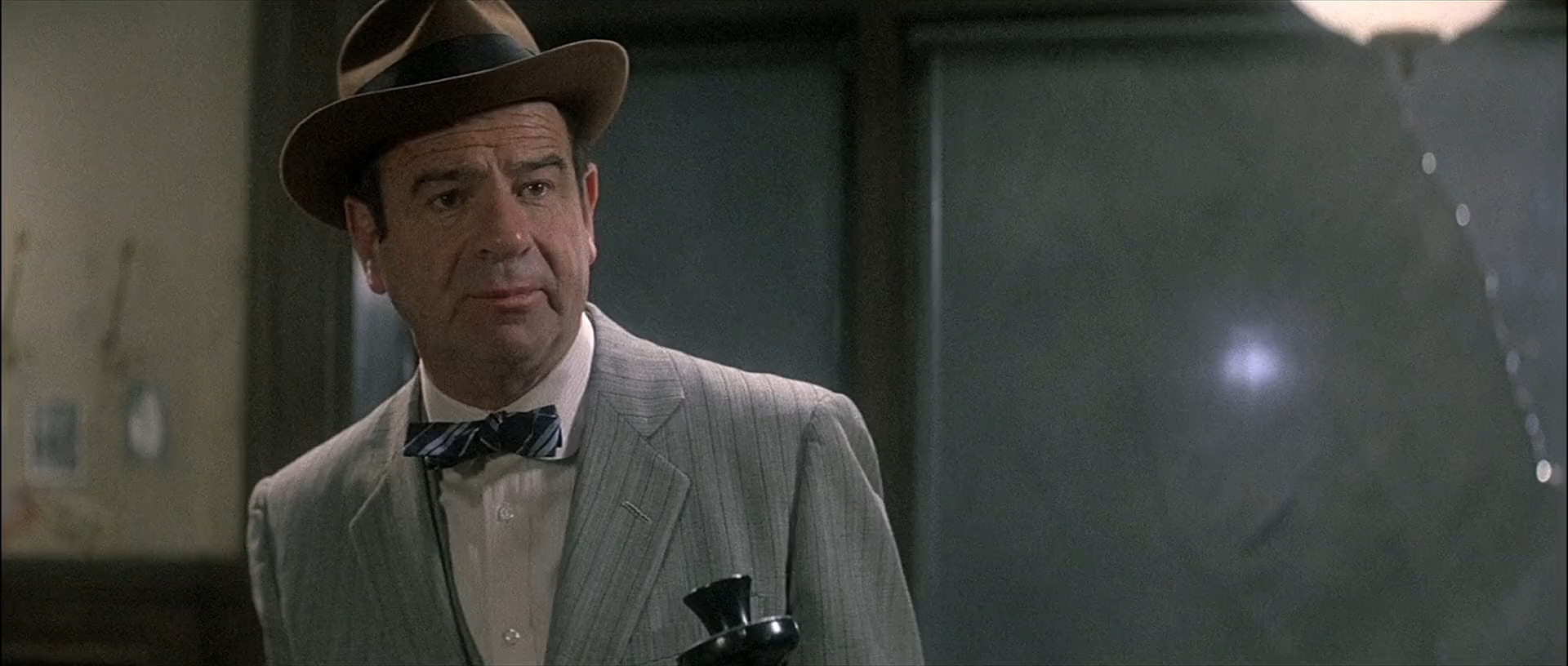
Billy Wilder's remake of Charles MacArthur and Ben Hecht's 1928 play occupies a snug but odd place in the filmographies of all those in it. A snapshot of the differing states of the careers of its actors, crew, and writers, if you will. Already brought to the screen (slightly censored from the stage version) in 1931 and again in 1940 as His Girl Friday, the story struck again while the iron was hot in the wake of Watergate and a slew of films themed around the era's paranoia. That, coupled with the wave of nostalgia films also ubiquitous for the rest of the decade (Paper Moon, The Great Gatsby, The Sting), likely spurred Universal to throw their newsboy cap into the ring as well.
Jack Lemmon as Hildy Johnson
Walter Matthau as Walter Burns
Susan Sarandon as Peggy Grant
Austin Pendleton as Earl Williams
Vincent Gardenia (center) as Sheriff "Honest Pete" Hartman
Adapted by Wilder's main scribe I.A.L. Diamond, TFP takes advantage of a great cast, relaxed 70s standards, and timely source material to produce an admirable if ultimately mixed result.
Above: the only weather-related indication that the film takes place in June.
Indeed, a fundamental flaw that is soon noticed with TFP is its timing, pacing, and relative lack of tightness in its energy and direction. Wilder seemingly aims for lines of dialogue to simply not overlap, which is often doom for a fast-paced satire.
After the film's excellent opening credits, it loses considerable momentum
once we see the press room and the competing newsmen in it.
On the upside, Lemmon and Matthau are great together, and Diamond's screenplay rightfully expands Matthau's role and accommodates their winning chemistry. The factors of the source material's dialogue, Matthau and Lemmon's quicker timing, and far worse outings such as Buddy Buddy and The Odd Couple II have given me a new appreciation of this film on recent rewatches.
get along with Wilder over their conflicting approaches to the film.
Tellingly, it's this portion of the film that seemingly has the most energy.
Gardenia is a standout, easily matching Matthau and Lemmon's energy
and making for a fun, blustery villain (relatively speaking).
Pendleton also fares well, adding a much-needed sweetness to the proceedings.
Make no mistake, TFP is not a long film (it's barely over an hour and forty minutes), but it can feel that way at times, especially in the first half. Perhaps Wilder was better off just allowing Matthau, Lemmon, and others to pick up the pace and inherent manic energy characteristic of the profession being satirized.
THE ROLE OF ADAPTATION
Diamond's script adds several new characters while removing several others, such as Hildy's future mother-in-law who Walter kidnaps (as hilarious as Matthau's Walter doing this would be).
Jon Korkes as Rudy Keppler
One of the best additions to this version, as it allows Walter to basically
troll Hildy from offscreen and emphasize Hildy's professional ego.
But the best immediate result of Diamond's adaptation is the expansion of Walter Burns' screentime, unsurprising given Matthau's star power and excellent casting.
I love how Walter just appears in the room here, a la Buddy Love.
The downside comes as a result of the aforementioned looser standards in language, as while Deliberate Values Dissonance is definitely in play here, the mentions of "f*ggot" and other words not in the original play come off as jarring and even a little cheap, especially given how characters already use terms like "red" and "pinko", (but not harsher versions of those words) in the period slang context.
And that's before getting into the cringey implied actions (to Keppler)
of newsman Bensinger (David Wayne).
Diamond does a decent job adding events and action outside of the press room
setting, including this (visibly) sped-up chase of squad cars rushing to
various alerts of Williams' whereabouts.
THE STUFF OF SLATES (AND THE REST...)
Wilder and Co. put together a stellar supporting cast for TFP. Loaded with character actors, Wilder regulars, and "before they were big"s, TFP's roster includes but is not limited to...
Herb Edelman (Stan on The Golden Girls and Murray in The Odd Couple (1968))
as Schwartz and Allen Garfield (Nashville, Beverly Hills Cop II) as Kruger
Charles Durning (Tootsie, The Muppet Movie, Peter Griffin's dad) as Murphy
Cliff Osmond (another Wilder regular) as Officer Jacobi, who was only mentioned in the play.
Harold Gould as the Mayor
Paul Benedict (Mr. Bentley on The Jeffersons) as Plunkett
THE REDHEAD IN THE ROOM...
Carol Burnett as Mollie Malloy
In the grand scheme of things, while not terrible at first, Burnett's portrayal of TFP's moral center is tonally mismatched to the rest of the film. My first viewing wasn't helped by having previously seen 1972's Pete 'n' Tillie, so imagine the whiplash seeing and hearing Burnett's pitched-too-high performance, almost diametrically opposed to the actors around her.
Some time after the film's release, after it was shown as an in-flight movie on a flight she was on, Burnett stood up, went on the attendants' P.A. system, and apologized to her fellow passengers for what they had just witnessed, to great applause.
THE STUFF OF PLATES
Despite its flaws, I've found myself coming back to TFP time and time again for its period detail, cinematography (by Jordan Cronenweth), lighting, and atmosphere. It's not a far cry from other period films of the 70s, but its setting and somewhat-claustrophobic feel (for its 2.39:1 aspect ratio) reminds me of rainy winter nights at home rather than Chicago in the summertime (which you'd think would be hotter than seen in the film, but who knows).
1974: A banner year for trains, fog, and white lights.
OTHER OBSERVATIONS
You know it's 1974 when the (intentionally) bland girlfriend is played by
Susan Freaking Sarandon, of all people.
The original Stormtrooper Aim.
Still shorter than the wait for Rex Kramer.
TIDBITS AND SUCH
TFP would later find itself featured (albeit with its clips out of order) in 2019's Dolemite is My Name (a film I highly recommend). It says something about TFP's place in film history when its most prominent appearance has it being lambasted by the main characters.
Like with its cinematography, another visual aspect of TFP that stuck with me was its great posters (U.S. and Japanese ones above). Given the amount that survives today in the form of posters, lobby cards, and foreign release materials, Universal seemed to have been gunning for a massive hit that ultimately fell a bit short.
The Front Page has found a new audience on DVD and Blu-ray, and while it's not deserving of being a mere footnote, its overall result leaves much to be desired, given its league of talent.
In my university's creative writing studies, workshopping, reading, and constructive criticism were vital parts of my scriptwriting classes, but all of those weren't nearly as pivotal in improving my skills as reading, rewriting, and adapting other scripts in my own time. Through that, I was basically forced to examine characters, tropes, and dynamics all the way down to the last detail, and how said details can make or break a character. Several of my adaptation ideas have sprung from how one kernel of a good idea or truth was in the material, but was surrounded by its mediocre execution, inconsistent tone, dated views, or a lack of greater subtext.
Walter Matthau as Trabucco
Jack Lemmon as Victor Clooney
Dana Elcar as Captain Hubris
Paula Prentiss as Celia Clooney
Klaus Kinski as Dr. Hugo Zuckerbrot
Buddy Buddy was the final cinematic collaboration between writer/director Billy Wilder and screenwriting partner I.A.L. Diamond, who had had monumental success with films such as The Apartment and Some Like It Hot.
Some Like It Shot: Lemmon and Matthau react to the film's disastrous reception.
Notorious Mob hitman Trabucco (Matthau), having just carried out hits on two witnesses in an upcoming court case, finds his third scheduled hit hampered by his encounters with suicidal television censor Victor Clooney (Lemmon).
An Americanized remake of the 1973 French black comedy L'emmerdeur (The Troublemaker, or A Pain in the Ass), Buddy Buddy's production suffered from an unpolished script (being written in just three months), and Wilder later expressed considerable disappointment in the finished product. (Kinski later denied that he was even in it, but you probably guessed that already.) Throw in a subplot with an experimental (for 1981, anyway) sex clinic and you've got a farce that's at best a mess and at worst a likely travesty.
And that's before getting into Matthau's inexplicably darkened eyebrows.
Between this film and Mixed Nuts (1994), I've become increasingly convinced that American adaptations of dark French comedies simply do not translate to a California setting (something about the spacious beaches, desert, and constant sunshine just kills the constant tension and claustrophobia often necessary for a darker comedy).
Cinematographer Harry Stradling Jr. (McQ) does great with the Riverside, CA setting,
but it just further drives home how ill-suited it is for this material.
The well-proven team of Matthau and Lemmon may yield some chemistry in Buddy Buddy, but with this writing, they come off as quite shallow compared to their previous outings together.
Wilder expressed regret in casting Matthau, citing how an actor like
Clint Eastwood could have lent a more serious tone to Trabucco.
A mistake I also found with Little Miss Marker (1980) is how Buddy Buddy's writingseems to simply "drop" Matthau into its humorless, "dour" lead role without consideration to his strengths as an actor. Trabucco's intentions may be clear and his exasperation with Clooney is understandable, but as is, it's not a good fit for Matthau and with the voice he puts on, it's a touch too cartoonish to fully gel with the world around him, emphasizing the tense state of Clooney in turn. Any attempt to adapt the source material was going to be a challenge, but said cartoonishness isn't great for tonal consistency.
Seriously, I love Jack Lemmon as much as the next guy, but those who dislike his
"Jack Lemmon-ness" will not be swayed by the character of Clooney.
Much like 1993's Last Action Hero (I know...), Buddy Buddy's relative lack of a grounded, established reality leaves the audience unsure when to laugh, if at all. With an increased crassness that was also present in Wilder's The Front Page (1974), and the other aforementioned issues, the film is left with a vacuum where the elements balancing out its dark premise should be.
On a side note, while Prentiss's performance isn't what one would consider "good",
her wackiness is very much welcome given how dull the film is up to that point.
THE STUFF OF TROUBLEMAKING (OR (LITERAL) PAINS IN THE ASS)
It would take a rather large article to describe all the points of awkwardness and lack of connective tissue in Buddy Buddy's script, but here are a few that stood out the most to me on first viewing.
Clooney's hanging attempt breaking the thin hotel water pipe is so obviously telegraphed,
it kills the comedic potential entirely.
The hotel housekeeper (Bette Raya), seeing a tied and gagged Clooney,
makes no attempt to free him, merely propping his chair back up.
Clooney and Trabucco giving a lift to a couple in labor and finding the sex clinic
could have been cut from the script entirely without affecting the main plot.
Celia and Dr. Zuckerbrot's attempt to silence Clooney to save the clinic from embarrassment
goes pretty much nowhere and they just leave the film for good afterwards.
(Also, how screwy does your movie have to be to make Klaus Kinski look like the "straight man"?)
SO HOW WOULD YOU DO IT?
Unlike a lot of other scripts I've come across, for all its apparent faults, Buddy Buddy is not one that brings easy answers for me as far as how I would write it. This is likely due to my comedic sensibilities not skewing as dark as this film or its source material, as well as not wanting to betray what L'emmerdeur writer Francis Veber was going for.
Would you make Trabucco more likable? Drier than Eastwood? Would you make Clooney less desperate? More sympathetic? Would you set clearer "good and bad" moralities so the audience can better figure out who to root for? How would you change the ending?
Spoiler alert: Stromboli,this ain't.
Again, this is a film that for me sparks lots of writing questions, but not so many answers. With better-received dark comedies springing up in the decades since, it can be easy to take them for granted in terms of their execution (no pun intended), but Buddy Buddy proves that even those as talented as Wilder and Diamond can't guarantee a surefire hit in the genre.
Pictured: the original Gil Gunderson.
Given its origins, archetypes, and tropes involved, Buddy Buddy makes for an excellent case study and foundational exercise for any screenwriter. (Though, regretfully, its script cannot currently be viewed online for free as of this writing.)
Matthau was badly injured performing the film's big laundry chute stunt.
TIDBITS AND SUCH
For all the picking-apart I've done with this film, I do have a soft spot for one of its U.S. posters (above). If only Clooney were as sweet and happy-go-lucky as the poster portrayed.
One aspect I found working like a well-oiled machine in Buddy Buddy is Lalo Schifrin's score, which is both classic-sounding and highly irreverent, fitting the film's tone (whether you think the film stuck the landing with it or not).
Having been out of print in North America for decades, Buddy Buddy is currently available to watch on YouTube.
Buddy Buddy is the comedic cousin to The Mirror Crack'd in terms of being a failed adaptation despite all the talent involved, but to even this writer's surprise, it's still not the worst Matthau and Lemmon film out there. (Thanks, Odd Couple II!)
"Can two divorced men carry out a Mob hit without driving each other crazy?"