When it comes to the smaller "setups and payoffs" of your script, the role of a running gag, "Chekhov's Gun", or the "rule of three" will be dependent on how much of the same or similar thing an audience will allow until they tire of it.
Introduce an important prop (the "Chekhov's Gun") without ever coming back to it later, and your audience will feel shortchanged. Go back to the well of a running gag too often, your audience will become tired and irritated.
You can call him Ray, or you can call him Jay,
he's just a visual aide, folks, that's all he is today.
Among other story factors, here are a few things to think about when implementing your little "repeat touches".
YOU DON'T HAVE TO DRAW LOTS OF ATTENTION TO THEM
A common mistake in writing has to do with a lack of subtlety in learning to weave detail into a story. To combat this, you could conceivably make a running gag out of something very minor, or introduce a "Chekhov's Gun" with even more subtlety than others.
While Rick Dalton is established early on as being handy with a flamethrower,
one could easily miss said flamethrower also being present in Rick's shed on first viewing.
Chekhov's Flamethrower
Good, nuanced screenwriting makes use of more than one sensory level for its details. Don't confine your running gags or "brick jokes" (seemingly-irrelevant gags or details that do have an unexpected callback or payoff) to just dialogue or story events. Audiences may expect certain types of props, jokes, or subjects to be not-so-subtle, so if you need to, don't hesitate to try scaling back your gag in question.
The running (done at least twice) gag of Otis and Eve's "I said that / I said it" back-and-forths
is stated merely in dialogue, and wasn't very funny in this writer's opinion.
Tellingly, this repetitive gag was cut entirely for Superman's theatrical cut.
GO WITH YOUR GUT (AND THINK LIKE A VIEWER)
How often will you implement your running gag? Will you adhere to the "rule of three" limit? Or scale back a bit and stop at just two instances? This is where (as if you haven't already) you should think like a moviegoer. Only you will know how this will all fit tonally and with what else your script is going for, but the attention of an audience is admittedly quite fickle. Unless you put a spin on it, writing a fourth instance of a running gag past the rule of three is a massive risk (and even with said spin on it). In the hyper-realistic medium of film, the human attention span has its limits, on both ends of the speed spectrum. Keep in the mind the eye of the viewer.
As of 2007, Homer Simpson has jumped or fallen down Springfield Gorge only
three times, with only the second time immediately following the first.
USE THEM TO BUILD YOUR CHARACTERS
For example, different characters will react differently to the same gag. Character S might react very differently than Character I, or they will give the same answer to two different, yet similar ideas or gags. Ideally, your gags or jokes shouldn't always just be there for the sake of having a joke (and pushing the story forward, important as that is).
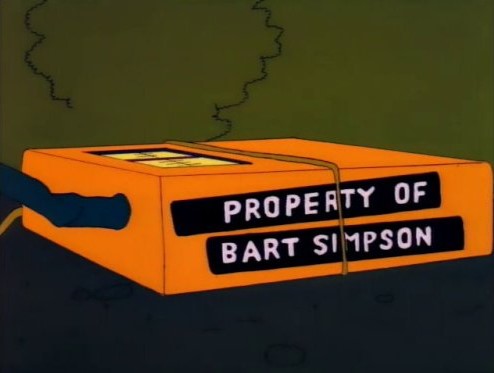
Bart's propensity for labelling everything with his new labelmaker
comes back to bite him in the ass in "Radio Bart".
Leaving aside character humor itself, since the "Chekhov's Gun" definitely needs a payoff and cannot be there for the sake of needing a prop, you could use it towards character as well. Who ends up using the now-important prop? Is it a surprise? Is it part of a twist even? Are they skilled at using it? Terrified of it but forced to use it now? Everything in your script should have a purpose, and ideally more than one purpose.
"I said, hop in."
The reemergence of Mr. Burns' Spruce Moose model plane
caps off his deteriorating mental state in "$pringfield".
DON'T FORGET THE "BAIT AND SWITCH" CARD
This is a good "cheat" to put a new spin on an old gag, or to switch up the third instance of a running gag. Is your running gag a condition or misfortune that is now affecting an unexpected character? Is a last instance of a gag now used in a more serious tone? Is the least likely character presumed to be qualified for a situation actually the most qualified for some absurd, but logical reason? Basically, you should always remember the power of subverting expectations.
The titular "Bart's Comet" breaks up into the size of a chihuahua's head,
exactly as predicted by (of all characters) Homer.
Running gags and the like are an aspect that will vary considerably and will (or should) be unique to their respective scripts, so hopefully with the above, I've gotten you to really think about how not to overdo a gag or underdevelop a "Chekhov's Gun", in the hopes of keeping your audience invested.
In the summer of 2006, I had just graduated elementary school. The summer after, I had just gotten my first set of braces, and the summer after that, I did my final year of parks and rec volunteering, as well as reacquainted myself with the production of 1978's Superman. In parsing those long-lost memories of that time a decade later, I realized that my mind had "congealed" those years together, and around the same setting, that being my orthodontist's office.
Funny how memory (and nostalgia) works.
Tying that unusual setting with Superman further was the heavily-marketed (and heavily-merchandised) release of Bryan Singer's sequel/homage/reboot/godforbidreimagining of Richard Donner's 1978-1980 Superman films, not to mention the optimistic, "clean slate" vibe permeating the cultural zeitgeist (and the new things I was learning about) in the mid-2000s.
Brandon Routh as Superman...
...a.k.a. Clark Kent
Kate Bosworth as Lois Lane
Kevin Spacey as Lex Luthor
With Superman films (yes, more than one) in development hell for the better part of 20 years, fans in 2006 were finally getting something, anything, that would erase the bad cinematic taste of Superman IV: The Quest for Peace, and honor the memory of the recently-departed Christopher and Dana Reeve. Donner's Superman and Richard Lester's Superman II had found new life on DVD a few years prior, and 2006 would also see the release of Superman II: The Richard Donner Cut, a more-than-slightly-patchworky but highly enjoyable amendment to what fans considered a nearly-thirty-year-old mistake.
With all that in mind, you can understand why Singer chose to go the way he did.
Well, partially.
Also recently released was 2005's Batman Begins, the first of the 2000s "dark and gritty" superhero films whose aesthetic has now been talked to death, analyzed, parodied, overused, and "congealed" to all hell, proving to ultimately be more profitable in the coming decade. (The Dark Knight would solidify that, but worldwide, Superman Returns actually outgrossed Batman Begins.)
For me, Superman Returns doesn't warrant a regular review or essay, because the place its existence holds in my memory is more than what's in it, but it also represents how transitional the mid-2000s really were, and how that possibly fed the impulse to go in perhaps the most self-sabotaging direction possible. With one foot in the Donnerverse camp and the other in the grittier 2000s camp, Superman Returns makes the cardinal mistake of wanting both and ultimately satisfying neither. And in the visual medium of film, wanting both is more than bad enough.
THE ROLE OF HOMAGE (AND TOO MUCH OF A GOOD THING)
Let me preface this by saying that I am a huge fan of Superman and The Richard Donner Cut, and as a screenwriter, I'm also a big believer in homage and "stealing like an artist".
So long as it's done subtly.
Very often in this film, dialogue either repeats or recycles dialogue and exchanges from the first film, with very little variation or twist on it. Plot points are recycled, settings are repeated with little variation, and characters aren't shown to have grown very much from before.
Which is a problem, seeing as the film is firmly established to be a sequel to the original Superman II.
Believe it or not, Brando's presence is one of the less
headscratching moments from this film.
Due to the state of Dan Harris and Michael Dougherty's script (seeming like a first draft or a fan film than an intended series-launching blockbuster), and some of the newer aspects not being at their strongest, Superman Returns' homages ring through clear as day and (ultimately) distractingly so. And because we can watch the first film and see Lois and Supes first fly together, it just further makes the dialogue and direction between Routh and Bosworth seem as cold as the night air itself.
Seriously, Routh and Bosworth have little to no chemistry, which is not good when
Lois Lane is supposed to at least swoon a little for Superman and barely notice Clark.
THE ROLE OF THE SCRIPT (AND THE FURTHER SUPER SHADOW)
Going back to the script itself, the glaring lack of connective tissue opens the film up to countless questions regarding the emotional core and internal conflict that started the film itself. What were the full circumstances of Superman leaving Earth? Did he know Lois was carrying his child? Why didn't he make sure Lex Luthor was in no position to wreak havoc again? It's especially jarring considering the answers and explanations to similar questions Donner and screenwriter Tom Mankiewicz had provided within the first two films.
Luthor henchman Stanford (Kal Penn) was originally intended to be a former
Daily Planetreporter bribed by Lex to plant false evidence and spur Superman
to leave Earth and look for Kryptonian survivors.
With its "pick and choose" method of how it approaches the minutia of the Donner films, Superman Returns often introduces new ideas without consideration of their ramifications, the biggest of which have to do with Jason White's conception. (Remember, both versions of Superman II involve Lois either forgetting that film's events, or said events no longer happening in the first place.)
Jason (Tristan Lake Leabu) being Superman's son may not have been intended as a twist,
but it sure does rob the movie of some much-needed tension.
Even on its own merits, Superman Returns is often cold, staid, and emotionless in its direction, dialogue, and lack of chemistry, which unfortunately stand out more coupled with its impressive visuals and effects, much of which do actually hold up.
Lex's new ship lair is an inventive new idea that is used to
much story potential, unlike most in this film.
And perhaps most importantly of all, due to said coldness, it makes it difficult at times to really care about the characters and their relationships, ironic given the visceral emotional weight of the films it's trying to homage.
In the 2006 frame of mind, one would think Spacey would be an excellent choice for the role of
Lex Luthor. But upon seeing the film, I found him oddly unfun and cold, an odd one out
considering how the other characters are written closer to their Donnerverse counterparts.
THE ROLE OF UPDATING (AND LITTLE ELSE)
In the years since, reboots of Star Trek and Transformers have (for better or for worse) managed to set themselves apart from their originals thanks to the risks and new directions taken by their directors. As much as the Snyderverse tried so hard to move away from the Donnerverse, at least you can't accuse Zack Snyder of not committing to his own vision.
While hewing too close to the first two films is Superman Returns' biggest issue, the sneakier one close behind is the integration of aspects characteristic of the modern superhero movie sensibility. Since much of the film is so adherent to the sunnier, "old-fashioned" vein, the scene of Lex brutally inflicting pain on Superman is so dark and unpleasant that it kills much of whatever fun it had up until that point.
"You mean the kryptonite shank?"
"Yes, I mean the kryptonite shank."
All of this means that Superman Returns, whether directly following the Donnerverse or not, is basically at war with itself. Had perhaps more time been given to smooth out the tonal shifts in the film's second half, the landing might have been stuck and the right balance might have been struck. But as is, it's almost a cautionary tale, warning of how the Snyderverse would approach superhero brutality for brutality's sake.
SO, IS THERE ANYTHING I LIKED?
I found that many of the things I liked best about Superman Returns are those that built upon the characters' personalities and progressed them (even if only slightly).
Routh is quite good as Superman and Clark, and it's just too bad
he didn't have a better script to work with.
Eva Marie Saint as Martha Kent
Despite little screentime, she's the anchor of the film's Smallville scenes,
and I missed her when she was off-screen.
Reality Ensues
A well-done scene of Clark looking at Lois amidst a sea of Daily Planet personnel,
which wouldn't have been out of place in the 1978 film.
Okay, I'm not gonna lie. That was pretty badass.
Frank Langella as Perry White
While always fun to watch, I was a little disappointed that Langella's
Perry was calmer and chiller than Jackie Cooper's.
(Maybe Perry was sneaking a few of Lois's nicotine patches?)
James Marsden as Richard White
While he could have gone the way many "Disposable Fiancé"s did in the mid-2000s,
Richard is actually a pretty nice guy who's understandably a tad wary of Superman,
but goes back to save him after Superman saves him, Lois, and Jason.
Sam Huntington as Jimmy Olsen
While a touch light by today's standards, Huntington is one of
the better-cast of Superman Returns' actors.
Parker Posey as Kitty Kowalski
While her part is underwritten, Posey brings life to the proceedings,
providing better chemistry with Superman than Bosworth does as Lois.
Lex cutting Kitty's brakes is not only a good little twist, but it's totally
in-character for both (and well, perhaps any) incarnations of Lex.
Noel Neill (Lois Lane in the Superman serials and the 1950s T.V. series)
as Gertrude Vanderworth
Lex "inheriting" Gertrude's fortune and Kitty's introduction strike
just the right balance between dangerous unease and villainous fun.
Jack Larson (Jimmy Olsen in the 1950s T.V. series) cameos as a bartender.
(This expression is very Matthau-esque, if you ask me.)
AN IRONIC AFTERWORD...
Adjusted for contrast, because my eyesight is even worse than Lois Lane's.
Going back to when Superman Returns was released and how it personified the good and the bad of the mid-2000s, it's recently occurred to me how double-edged of a sword memory and nostalgia can be. Not that things could never be as good as one remembers them, but as a writer, if you're using nostalgia as a creative influence, it's important to remember that merely inserting your nostalgia wholesale could stifle your creativity.
The way my mind worked, it "painted a bigger picture" and preserved the positive emotion and images from the period, rather than cold, hard facts. While that was a good start to set a story in, it still needed human beings, their emotions, dynamics, storytelling, a sense of progression, and even nostalgia from other periods in my life. Add Superman and my script's source material, and you have the mood that became the basis for my (as of this writing) current screenplay project today.
So basically, indirectly, and a whole lot ironically, I probably owe this movie a lot for what its existence reminded me of, rather than anything actually in it. That is, I was reminded of the Donnerverse Superman representing goodness and kindness in the modern era, with his enemy being cynicism.
A two-mooded film inspiring a two-sided criticism. Who knew?
TIDBITS AND SUCH
John Ottman's score, integrating new themes with John Williams' classic Superman themes, is objectively the best part of the film and deserves a listen. Below is the "Main Titles" theme.
Seriously, someone should pair this soundtrack with edits from the 1978 film.
Prior to Routh reprising the role for The CW's Crisis on Infinite Earths event, Superman Returns had been forgotten by the mainstream for many years, but I think those wanting a time capsule of the superhero film mentality of the mid-2000s will find lots to chew on.
As for myself, I'll instead take what its time reminded me of, rather than the film itself. In this case, nostalgia is better than it used to be.
For my (as of this post, still-) current script project, I thought I would give a general rundown of how I came to fashion it into what it is now, beyond merely what inspired it and what I wanted to see.
THE SPARK
I had the idea for my current script in the back of my mind for quite some time, but I had also put it there due to the older age of the character in it I had in mind for myself. When I graduated and got my Bachelors in Creative Writing, I had more free time to dive into a new script project and set it in my hometown of Nanaimo. Also, I had no other script ideas with this many legs.
THE "SKELETON"
Since this was going to be an adaptation of another screenplay, the original "skeleton" had somewhat been done for me, but I already had a good idea how the first major event was going to go in my version, even before writing it. Also, I watched the original, to get a sense of what its creators were going for, along with its tone, cultural context, cultural reference points, and its time period.
Writing the "skeleton", however, was something else. Of course, the bigger event and character changes were incorporated, but the resulting draft was still very rough, not to mention time-consuming in general. For a time, I had a different idea regarding one character's motivation, but I soon threw this out entirely in favor of another idea.
Despite being devoid of the finer character details, some nuance, and dialogue detail, this first draft still served as a vital foundation for me going forward.
THE "THINKING"
Now when I call this step "thinking", I mean thinking through the countless other changes to fully flesh out my script. What directions was I going to take? What tones was I going to shift into in addition to my main one? How nice were these characters going to be? What were their flaws? What were their inner workings and how much would they affect the story? All of the above (and more) was going to affect everything else in the script.
THE SUBTEXT, CONTEXT, AND "WINDOW DRESSING"
Once most of the new changes and contexts were staying in place, part of the fun was adding regional detail and basing them on real civic events in my town. (Those in Nanaimo will very much know what I'm talking about.)
This also extended to culturally translating the reference points that were dated if not outright obsolete. Since I've only grown up in Nanaimo, I could incorporate its general vibe, history, economics, issues, and local hockey culture to inform the characters' dispositions and viewpoints. (And that's before getting into the role of Superman(1978).)
A literal "T" chart updating one of my script's characters, who naturally
"absorbed" a noticeable amount of Nanaimo's sunny energy.
Once I nailed down the characters and their personalities in my script, I could add the little set and clothing touches that also provided cultural in-jokes or ironies, nostalgic associations, etc.
THE MUSIC
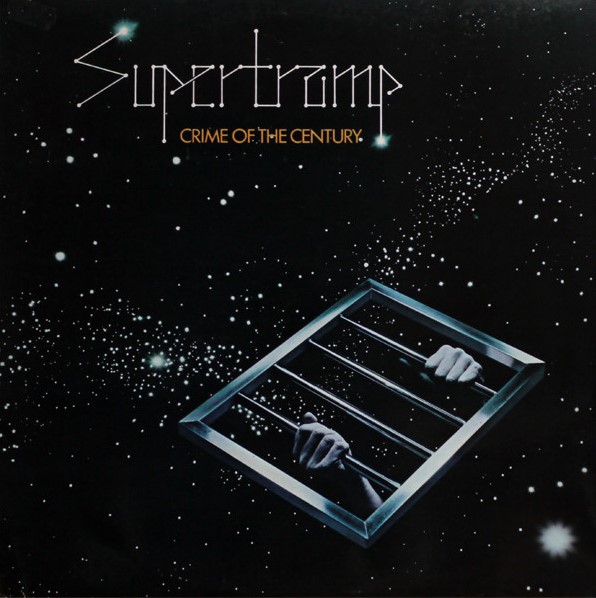
Since the music of Supertramp and ELO fit the dreamy, mid-to-late-70s vibe of my project, I dove into their discographies to further my nostalgic associations and "plug them into" my script. With a couple of my song choices striking such a unique tone, I partially rewrote several small scenes to fit the music. At other points, songs such as 10cc's "I'm Not in Love" help to give the audience some added subtext, etc. regarding other things about the story.
THOSE LITTLE, "EVEN JUST A WORD" REFINEMENTS
Due to the vast personality changes involved in the adaptation, I had to comb dialogue down to the letter in order to fully smooth things out. A single word can mean the difference between egotistical and modest, after all. Oftentimes, I didn't seek out these discrepancies, but rather they "came to me" suddenly, a result of having read the script over and over again. (Another upside to doing that is that you'll remember lines to a T.)
With time, some things might come to you that are so obvious, you'll wonder how you didn't think of them before.
In addition to Superman, I wanted to incorporate Nanaimo's local nature and landscape. The view of the city skyline with Seacrest Apartments and the Beacon, the abundance of Arbutus trees, the shimmering morning waters of Newcastle Channel, the Harbourfront Walkway, etc.
Also, I had the time to go to the real-life settings in my script. Bowen Complex's pottery room, where I had volunteered in my teens, provided much detail to my script, i.e. the sounds (echoes), the tools, the personnel, the nostalgia, etc. By adding that little dose of real-world realism, the audience would better get acquainted with this setting in an atmospheric sense.
Bowen Complex Pottery Studio, circa 2000s.
Of course, gathering these details was also done in my daily life, from work to errands to other everyday activities, teaching me to be observant of even the smallest details I used to usually miss, and never seeming like actual "work" in the process.
Anyone in Nanaimo will recognize the nostalgic Canadian appeal
these images can evoke in the medium of film.
With doing all of the above in the past year or so, I've noticed my script "influence" me in terms of my outlook, in addition to what I wanted to do with its story and how I wanted it to affect people.
Also, I've gotten to really know Nanaimo, its areas, its streets, its history, and all that makes it Nanaimo and nowhere else. Since there's so much unique about it, I can't fit absolutely all of it into one film, so there's much potential for other projects to feature it in the future.
So I hope this post has shown you that any decent script takes time to write, and how my process unfolded in not only synthesizing my influences and goals, but also got me to nail down my tendencies as a writer and how to maximize their full potential.
Now here is a proper place to put this gif.
Because even typewriting monkeys need time to write Shakespeare.
To read of my viewpoints, tips, and "cheats" regarding adaptation, remakes, and attention to detail in writing, click here to explore my "Screenwriting" tag.